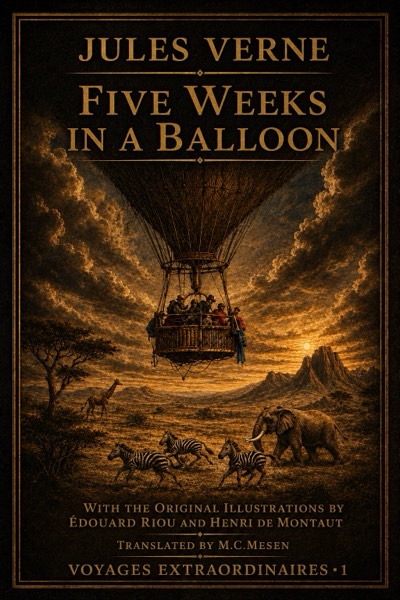
Voyages Extraordinaires · No. 1
Five Weeks in a Balloon
In the autumn of 1862, the venerable Royal Geographical Society of London gathers to witness something unprecedented: Dr. Samuel Fergusson, a scholar of remarkable composure and ingenuity, proposes to cross the entire African continent from east to west by balloon. His plan is no mere fantasy or reckless gamble, but the result of years of meticulous study—a machine designed to conquer the air with the steadiness of a ship upon the sea. The Victoria, as he names his aerostat, is a marvel of lightweight construction, hydrogen management, and mechanical control, built not for drifting but for directed flight. Yet for all its technical elegance, the enterprise remains audacious beyond measure, for no man has ever attempted such a sustained aerial voyage into a continent whose interior was, at the time, largely a blank upon the map.
Accompanying Dr. Fergusson are two companions as distinct in temperament as they are steadfast in loyalty. Dick Kennedy, a Scottish hunter of formidable skill with a rifle and a man deeply sceptical of the entire venture, provides a grounding presence—his pragmatism and courage serving as a counterweight to the doctor's visionary air. And then there is Joe, the doctor's devoted servant, whose resourcefulness, good humour, and unshakeable faith in his master lend warmth and resilience to the expedition. Together, these three souls ascend over the coast of Zanzibar and commit themselves to the unknown, suspended between the earth beneath them and the heavens above.
The Africa they traverse from the basket of the Victoria is a continent of staggering diversity and danger. Beneath them unfold savannahs teeming with herds of elephants and giraffes, dense jungles harbouring unknown tribes, vast lakes whose waters had only recently been glimpsed by European explorers, and deserts where the heat shimmers like water upon the sand. They encounter storms that hurl the balloon toward the earth, oppressive calms that threaten to strand them indefinitely, and the constant challenge of managing altitude, ballast, and provisions with mathematical precision. Each day brings fresh marvels and fresh perils, from the roar of lions beneath the canopy to the sight of villages whose inhabitants gaze upward in wonder at the strange vessel crossing their sky.
Yet for all its breathtaking scenery and heart-pounding episodes of survival, Five Weeks in a Balloon is also a meditation on the spirit of exploration itself—the tension between scientific ambition and human vulnerability, between the desire to know the world and the humility required to endure its mysteries. Verne weaves geography, ethnography, and invention into a narrative that feels both remarkably prescient and timelessly adventurous. The Victoria becomes not merely a mode of transport but a symbol of human aspiration, carrying its occupants—and its readers—into territories where imagination and reason travel side by side, the horizon always just ahead.