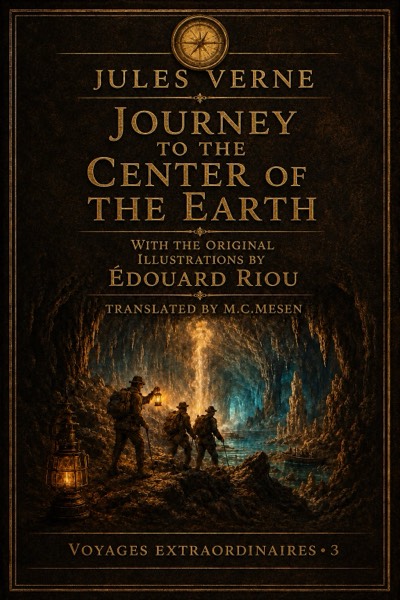
Voyages Extraordinaires · No. 3
Journey to the Center of the Earth
In a modest house on Königstrasse, in the old quarter of Hamburg, lives Professor Otto Lidenbrock, a mineralogist of formidable intellect and even more formidable temper. He is a man who reads the language of stones as others read a familiar book, who can identify a specimen by the merest glance at its cleavage and lustre. But one spring day, a discovery utterly unlike any other falls into his hands: a worn, cryptic manuscript hidden within the pages of a medieval Icelandic saga. Scratched into the vellum by a sixteenth-century alchemist named Arne Saknussemm is a message—an encoded triumph, a claim so audacious that it defies every known law of geology. Saknussemm, it says, has found the passage to the centre of the Earth, and he has left the way open for those brave enough to follow.
Lidenbrock, of course, cannot resist. Within days he has deciphered the code, packed his instruments, and dragged his reluctant nephew Axel—the young man through whose eyes we experience the journey—into a headlong departure for Iceland. Axel is a gentle soul, a student of science in his own right, but cautious where his uncle is reckless, doubtful where Lidenbrock is certain. He loves his cousin Gräuben, who is to become his wife, and he dreads the prospect of a descent into a world from which no one has ever returned. Yet despite his protests, he is swept along by the force of his uncle's conviction. In Reykjavík they secure the services of Hans Bjelke, an Icelandic eider-duck hunter of few words and unshakeable composure, who will guide them to the volcanic crater of Snæfellsjökull—the gate, according to Saknussemm, to the underworld.
What awaits them below the surface is a journey through realms that defied the imagination of nineteenth-century science. Down a chimney of basalt they descend, into tunnels that branch like the roots of an inverted tree, past seams of coal and copper, through caverns filled with the crystal skeletons of prehistoric creatures. The deeper they go, the more the certainties of the world above begin to crumble. The temperature does not rise as theory predicts; the geological strata repeat in impossible patterns; and at last they emerge into a vast subterranean sea, lit by an eternal electrical glow, its shores bordered by gigantic mushrooms and the bones of monstrous reptiles. Here, deep within the Earth, time itself seems to have taken a different course.
Journey to the Center of the Earth is perhaps Verne's most purely imaginative work—a novel in which scientific speculation becomes a kind of poetry, and the bowels of the planet are transformed into a realm of sublime wonder. It is also a story about the relationship between the headstrong visionary and the cautious observer, between the drive to know and the humility to wonder. Lidenbrock's exuberance and Axel's anxiety form the emotional heartbeat of the descent, while Hans, the imperturbable guide, reminds us that courage often speaks in silence. Verne drew on the geological debates of his time, but transcended them, creating a myth that continues to invite new generations to ask: what lies beneath our feet, in the darkness we have never explored?