Voyages Extraordinaires · No. 8
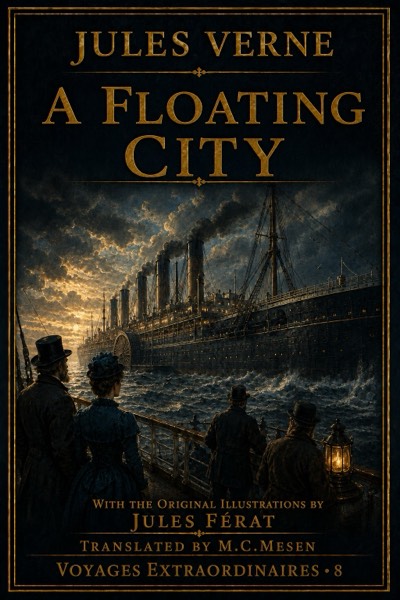
A Floating City
In the spring of 1867, the greatest vessel the world had ever seen prepared to cross the Atlantic. The Great Eastern—that colossal iron steamship, the product of Isambard Kingdom Brunel's audacious vision—was a ship unlike any other: a floating leviathan more than two hundred metres in length, capable of carrying over four thousand passengers, propelled by both paddle wheels and a screw, and equipped with luxury that rivaled the finest hotels of London and New York. Among her passengers on that maiden voyage from Liverpool to New York is an unnamed narrator—a keen-eyed observer who has come not merely to travel, but to witness the strange, encapsulated society that forms when so many souls are assembled upon the open sea, isolated from the world for the duration of a crossing.
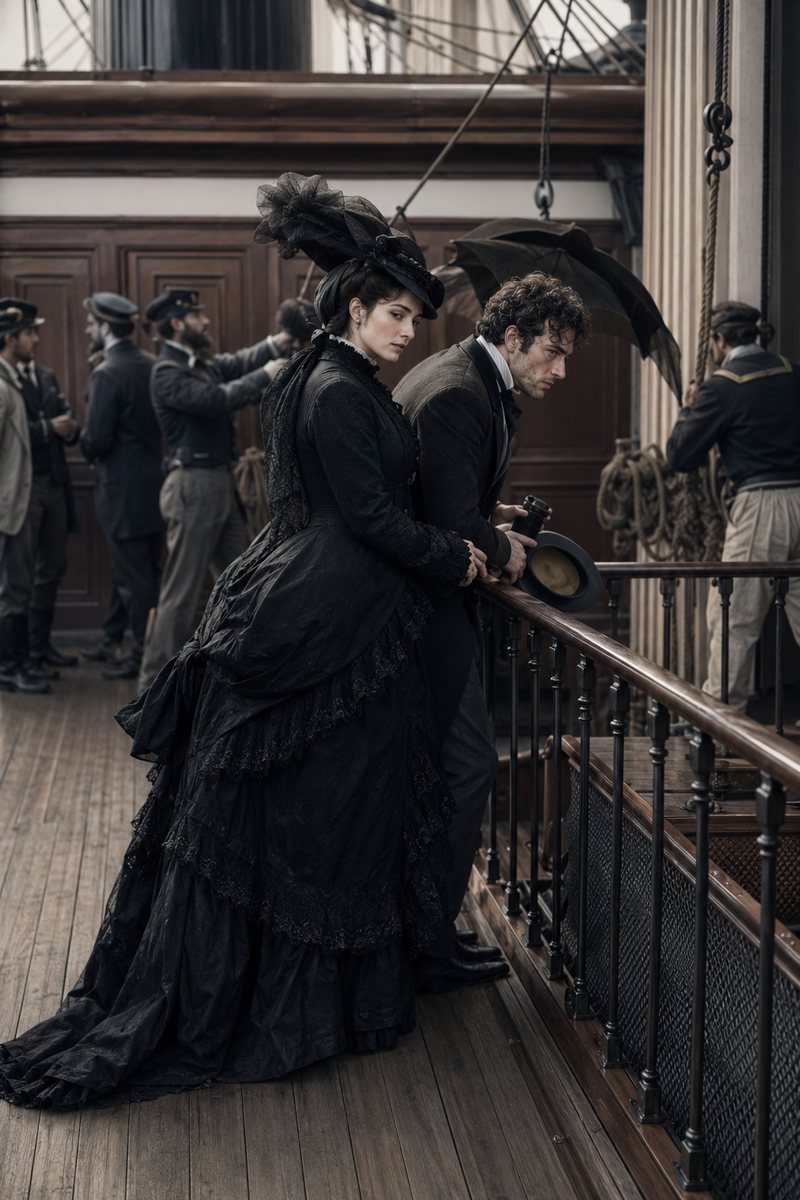
The Great Eastern herself is a character of almost mythological proportions. Verne, who had crossed the Atlantic on her earlier in his own life, renders the ship with loving detail—her immense engines, her grand saloons, her decks alive with the bustle of passengers from every station of life. But as the voyage progresses, a story begins to emerge from the crowd. The narrator encounters a man named Fabian, a passenger of striking melancholy, whose haunted expression betrays a grief too deep for casual conversation. And then there is Ellen, a woman of enigmatic beauty, whose presence aboard the same ship ignites a drama of memory, love, and rivalry that unfolds against the backdrop of the vast and indifferent ocean. Around these two figures, a web of relationships tightens with each passing day.
The crossing itself is no placid interlude. The Great Eastern must contend with the full fury of the North Atlantic—storms that dwarf even her immense bulk, waves that crash over her towering sides, and the ever-present tension of a machine pushed to its limits. Below decks, the enormous engines labour ceaselessly, a throbbing heart at the centre of the floating city. Verne, as always, delights in the technical marvels of his age: the telegraph that connects the ship's bridge to her engine room, the complex system of watertight compartments, the luxurious fixtures that make the vessel a world unto itself. Yet the true drama lies not in the machinery, but in the human heart. Fabian's sorrow, Ellen's secret, and the approaching confrontation with a figure from their shared past create a narrative tension as taut as any storm at sea.
A Floating City is one of Verne's more intimate works, a novel in which the extraordinary setting serves as the stage for a story of deep personal feeling. It is part travelogue, part social observation, and part romantic drama, woven together with the author's characteristic warmth and narrative grace. The Great Eastern becomes a metaphor for the modern world—the convergence of strangers, the compression of time and distance, the strange intimacy of life lived in transit. And beneath the surface of the voyage runs a current of mystery, a story of love and loss that travels alongside the ship like a shadow on the waves. It is Verne at his most human—less concerned with the marvels of science than with the marvels of the heart, and the unpredictable currents that carry us toward our destinies.