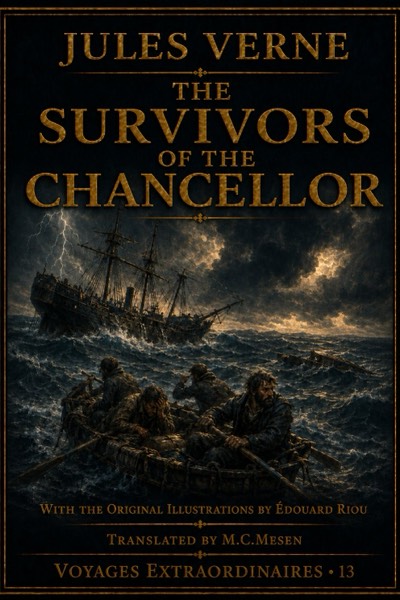
Voyages Extraordinaires · No. 13
The Survivors of the Chancellor
Published in 1875, The Survivors of the Chancellor is one of Jules Verne's most intense, dark, and dramatic novels. Within the Voyages Extraordinaires, it holds a special place by departing from the luminous tone of many scientific adventures to explore a limit experience: survival under extreme conditions.
The novel adopts the form of a diary, lending the narrative an immediate and almost documentary force. The narrator, J.R. Kazallon, travels aboard the Chancellor, a merchant ship crossing the Atlantic. The voyage seems ordinary, but a series of reckless decisions and hidden dangers transforms the journey into a deadly trap.
The ship catches fire, is damaged, loses its course, and becomes a floating prison for its passengers. Provisions dwindle, hope fades, and Verne leads the reader toward one of the most extreme settings in his work. Yet the most powerful element is not the succession of dangers but the psychological and moral degradation that survival at its limits provokes.
The Survivors of the Chancellor can be read as a shipwreck novel, but also as a reflection on the limits of the human condition. Its tension arises not from marvelous machines or scientific enigmas, but from the fragility of a group of people abandoned to the ocean and to their own fears.