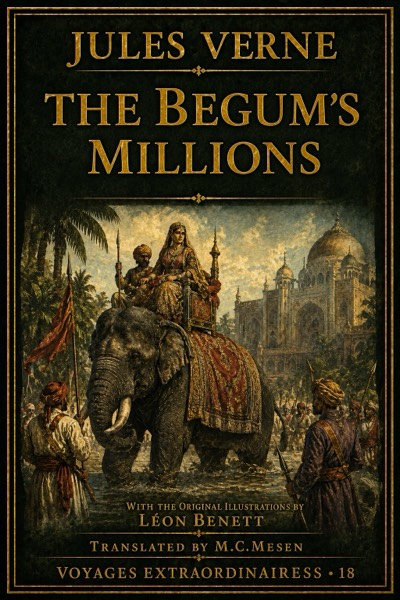
Voyages Extraordinaires · No. 18
The Begum's Millions
Published in 1879, The Begum's Millions is one of Jules Verne's most prescient and provocative novels. It blends social commentary, science fiction, and political allegory into a story about two opposing visions of the future — and the conflict that arises when utopia and dystopia begin to converge.
The novel opens with an extraordinary inheritance: the immense fortune of the late Begum of Ragginahra is divided between two distant relatives — Dr. Sarrasin, a French physician dedicated to the welfare of humanity, and Herr Schultze, a German scientist of ruthless ambition. Each uses his share to build a model city reflecting his ideals. Sarrasin creates France-Ville, a haven of health, knowledge, and democratic harmony. Schultze builds Stahlstadt, a grim industrial fortress dedicated to weapons, secrecy, and power.
The contrast between the two cities drives the narrative. While Sarrasin dreams of progress through cooperation, Schultze perfects a weapon of terrifying capability, viewing his rival's idealism as weakness. Their clash is not only personal but ideological — a confrontation between two ways of organizing human life, written decades before the great conflicts of the twentieth century.
Verne balances the tension with adventure and intrigue, introducing Marcel Bruckmann, a young Alsatian who infiltrates Stahlstadt, and Colonel Hendon, a military man caught between duty and conscience. The Begum's Millions is a remarkable novel of ideas that remains startlingly relevant, a cautionary tale about the choices that shape civilizations.