Voyages Extraordinaires · No. 20
The Steam House
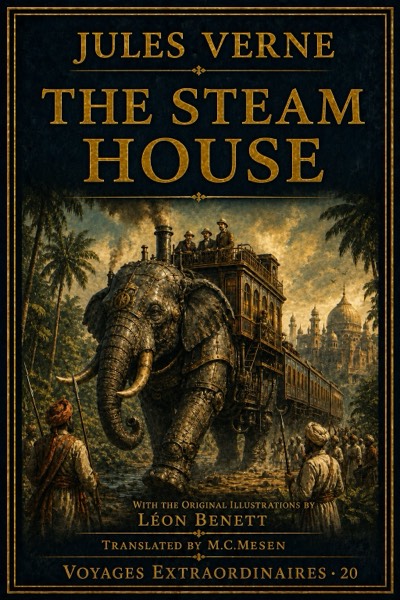
Published in 1880, The Steam House (also known as The Demon of Cawnpore) is one of Jules Verne's most inventive novels, combining mechanical wonder, adventure, and the turbulent history of British India. At its heart is a remarkable vehicle — a mobile home powered by steam, shaped like an elephant — that carries its passengers on an unforgettable journey.
The story brings together a group of travelers crossing India in this extraordinary machine, led by the enigmatic Colonel Munro. An English officer carrying a burden of personal tragedy, Munro is haunted by the events of the Indian Rebellion of 1857. His quest for justice and closure intertwines with the journey of the steam house itself, a creation of the brilliant engineer Banks.
As the travelers traverse the subcontinent, they encounter breathtaking landscapes, ancient cities, and the living memory of a conflict that shaped modern India. The mechanical elephant — a marvel of Victorian engineering — becomes both a home and a symbol of their passage through a land of contrasts. But the past is not easily left behind, and the rebel leader Nana Sahib lurks in the shadows, his own unfinished business driving the narrative toward a dramatic confrontation.
The Steam House is a novel of two journeys: one across the physical geography of India, the other through the emotional landscape of memory, revenge, and reconciliation. It showcases Verne's fascination with machinery while never losing sight of the human stories that give adventure its meaning.