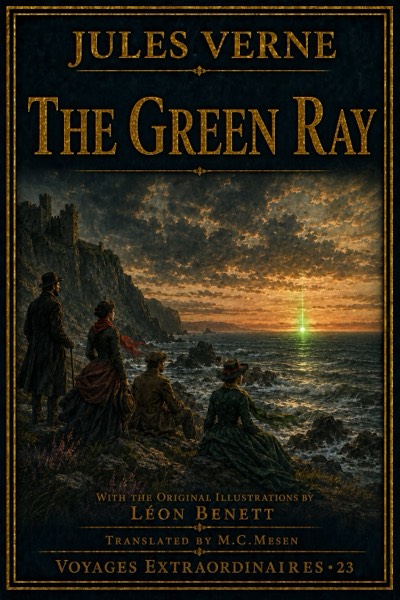
Voyages Extraordinaires · No. 23
The Green Ray
Published in 1882, The Green Ray is one of Jules Verne's most delicate and poetic novels. Part travelogue, part romantic comedy, it follows a young woman's quest to witness a rare atmospheric phenomenon — the last green flash of the setting sun — said to reveal the truth of one's heart.
Helena Campbell, an orphaned young lady, lives under the guardianship of her uncles, Sam and Sib Melville. When she learns of the legendary green ray — an emerald gleam that appears on the horizon at the exact moment the sun disappears into the sea — she becomes determined to see it. According to an old Scottish legend, whoever witnesses the green ray gains the gift of seeing into their own heart and recognizing true love. But her uncles, fearing the consequences, conspire to prevent the phenomenon from reaching her in the expected way.
The journey takes the party from the Hebrides to the coasts of Scotland — across lochs and islands, aboard sailboats and through wild landscapes. Helena is accompanied by an artist named Oliver Sinclair, a young man whose presence she finds both irritating and intriguing. As the group sails from island to island, chasing the perfect sunset, the romantic tension between Helena and Oliver grows, guided by the uncles' well-meaning schemes.
Verne fills the novel with luminous descriptions of the Scottish highlands and seascapes, capturing the interplay of light and water with painterly precision. Beneath its lighthearted surface, The Green Ray is a meditation on love, destiny, and the moments of beauty that can change a life — all culminating in a climax as brief and unforgettable as the ray itself.