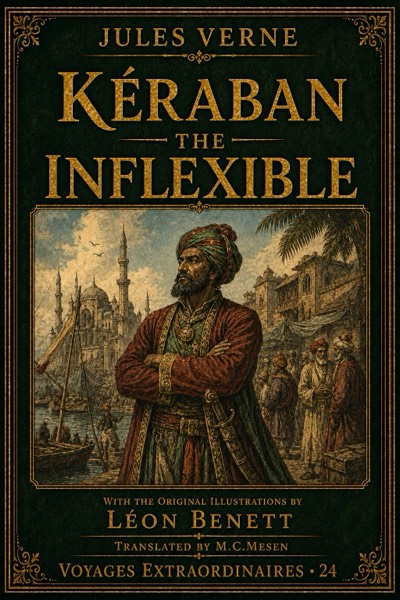
Voyages Extraordinaires · No. 24
Kéraban the Inflexible
Published in 1883, Kéraban the Inflexible is one of Jules Verne's most spirited comedies of character. A voyage novel driven not by necessity but by sheer stubbornness, it follows a Turkish merchant who would rather cross an entire sea than pay a single para of an unjust tax.
Van Mitten, a Dutch tobacco merchant, arrives in Constantinople to finalize a business deal with his friend Keraban. But Keraban, upon learning of a new tax imposed on all vessels crossing the Bosphorus, refuses point-blank to pay. Instead of crossing the narrow strait to his home on the Asian shore, he declares he will travel all the way around the Black Sea — an epic circumnavigation that will take him through the Ottoman Empire, the Caucasus, and beyond.
Accompanied by the reluctant Van Mitten, his dutiful nephew Ahmet, and the loyal servant Nizib, Keraban sets off on a journey that tests every limit of patience, endurance, and navigation. They encounter storms, bandits, shipwrecks, and officials who are every bit as stubborn as Keraban himself. Along the way, the obstinate merchant's uncompromising nature is repeatedly challenged by the complexities of the very world he refuses to accommodate.
Verne brings the Black Sea region to vivid life — from the bustling markets of Constantinople to the wild coasts of Circassia, from the Ottoman cities to the Crimean shores. Beneath its comic surface, the novel raises a timeless question: at what point does principle become folly? Kéraban the Inflexible is a rollicking travel adventure and a warm portrait of a man too stubborn to ever admit he might be wrong.