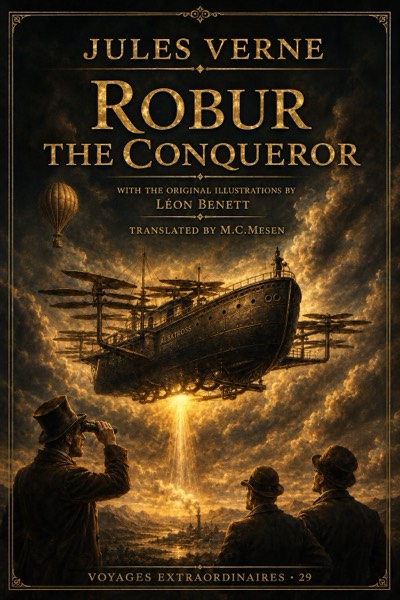
Voyages Extraordinaires · No. 29
Robur the Conqueror
Published in 1886, Robur the Conqueror is Jules Verne's visionary novel of flight — a story that imagined heavier-than-air aviation decades before the Wright brothers. Filled with invention, rivalry, and aerial wonders, it introduces one of Verne's most fascinating characters: a genius who believes the future belongs to the skies.
The story begins at the Weldon Institute in Philadelphia, a club of ballooning enthusiasts led by the pompous Uncle Prudent and his secretary Phil Evans. Their comfortable certainties are shattered when a mysterious figure named Robur bursts into their meeting. Robur, an aeronautical genius of formidable intellect and temperament, declares that the future of flight lies not in balloons but in heavier-than-air machines. To prove his point, he kidnaps Prudent and Evans, taking them aboard his incredible flying machine, the Albatross.
The Albatross is a marvel: a gigantic aerial vessel driven by electric propellers, capable of circling the globe. As Robur and his unwilling guests soar across continents and oceans, the captives witness a world seen from above — mountains, deserts, cities, and seas — while plotting their escape. But Robur is no mere villain; he is a visionary driven by the conviction that humanity's destiny lies in the conquest of the air.
Verne's imagination soars in this novel, anticipating the age of aviation with uncanny prescience. Robur the Conqueror is a thrilling aerial adventure, a clash of scientific philosophies, and a portrait of a man so far ahead of his time that the world can only see him as a threat. The sequel, Master of the World, would continue his story.