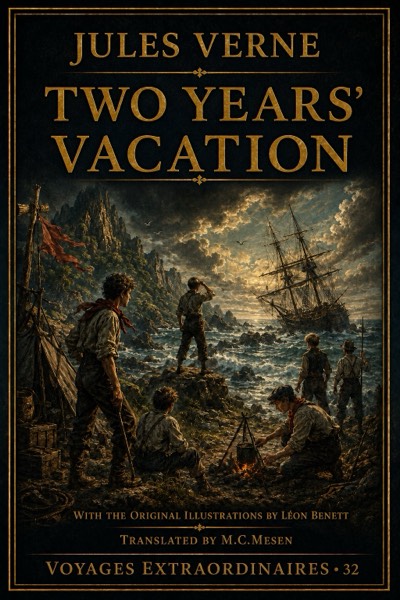
Voyages Extraordinaires · No. 32
Two Years' Vacation
Published in 1888, Two Years' Vacation is Jules Verne's ultimate castaway story — a novel that takes the classic desert island premise and adds a unique twist: the castaways are children. Inspired by The Swiss Family Robinson and Robinson Crusoe, it is a gripping tale of survival, leadership, and growing up.
A group of schoolboys from Auckland, New Zealand, sets sail on a holiday cruise aboard the schooner Sloughi. But disaster strikes: the ship is caught in a violent storm and, with no adult aboard, drifts helplessly across the Pacific. When the boys finally wash ashore on an unknown island, they find themselves alone, without parents, teachers, or anyone to guide them.
The boys must organize themselves into a functioning society. Gordon, an American student, emerges as the natural leader, guided by reason and fairness. Briant, a French boy, becomes his trusted lieutenant. But not everyone accepts Gordon's authority: Doniphan, the bully, challenges the leadership at every turn, while Jack, Briant's impulsive cousin, adds to the chaos. Moko, the ship's boy, contributes practical knowledge and humor. Together, they must hunt, build shelter, govern their small community, and face the dangers of the island.
Verne explores themes of democracy, cooperation, and the transition from childhood to responsibility. The boys face not only the natural challenges of the island — wild animals, storms, and scarcity — but also the internal tensions of their fragile society. Two Years' Vacation is a story of adventure and self-discovery, a classic of youth literature that asks what kind of adults children can become when left to their own devices.