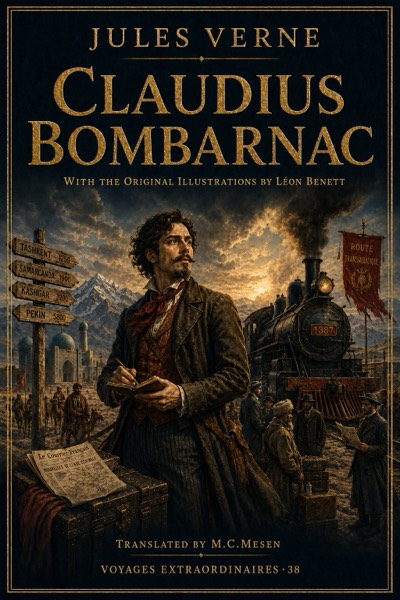
Voyages Extraordinaires · No. 38
Claudius Bombarnac
Published in 1892, Claudius Bombarnac is Jules Verne's great railway novel, a panoramic journey aboard the Great Transasiatic Express from the shores of the Caspian Sea to the walls of Peking. The novel is framed as a journalist's dispatch: Claudius Bombarnac, a French reporter, has been commissioned to chronicle the maiden voyage of the longest railway line ever built, and he approaches the task with the sharp eye and ready wit of a born storyteller.
The train becomes a microcosm of the world itself. Bombarnac shares his compartment with a dazzling array of fellow passengers: Fulk Ephrinell, an American traveler whose relentless energy and commercial instincts never rest; Major Noltitz, a stoic military man carrying the weight of imperial duty; and the Baroness Weissschnitzerferd, an eccentric European aristocrat whose unpredictable behavior keeps the entire carriage on edge. Each passenger carries a story, and Bombarnac means to collect them all.
As the train crosses the vast landscapes of Central Asia — deserts, mountains, steppes, and ancient cities — Verne fills the journey with incident. There are mechanical breakdowns, political tensions, unexpected stops, and the constant threat of delay. The novel moves with the rhythm of the rails themselves: steady, inexorable, punctuated by sudden drama. Through Bombarnac's chronicle, Verne captures both the romance and the absurdity of long-distance travel.
Claudius Bombarnac is above all a celebration of the journey itself — of the stories that emerge when strangers are confined together, of the landscapes that unfold outside a train window, and of the reporter who understands that the real news is not the destination but the passage.