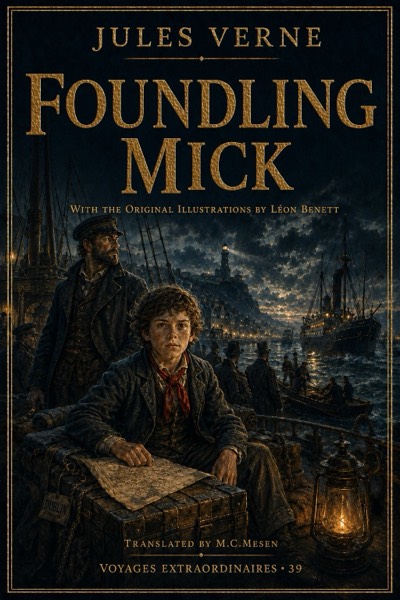
Voyages Extraordinaires · No. 39
Foundling Mick
Published in 1893, Foundling Mick (original French title: P'tit-Bonhomme) is among Jules Verne's most socially conscious novels, a work that trades the usual scientific marvels for a raw and moving portrait of poverty in nineteenth-century Ireland. Young Mick — an orphan without name, family, or prospects — begins his life in the mean streets of Dublin, where survival depends on wit, luck, and an indomitable inner flame.
Mick's early years are a catalogue of hardship. Abandoned to the care of Aunt Grip, a woman whose cruelty is matched only by her greed, he endures neglect and exploitation. But even in the darkest circumstances, Mick's spirit refuses to break. His encounters with the world beyond his oppressor's reach reveal an intelligence and resilience that begin to carve a path toward something better.
The novel traces, with Dickensian intimacy, Mick's gradual ascent from the depths of misery toward a life of dignity. Along the way he meets Little Sissy, a fellow orphan whose friendship becomes his anchor, and Mr. O'Bodkins, a kind philanthropist whose intervention opens doors that poverty had sealed. Verne's Ireland is vividly rendered — its landscapes, its social divides, its language, and its music all woven into the fabric of the story.
Foundling Mick is Verne at his most human. Without abandoning adventure, he turns his gaze to the social struggles of his time and produces a novel of genuine warmth and moral power — a testament to the idea that no beginning, however desperate, determines the end.