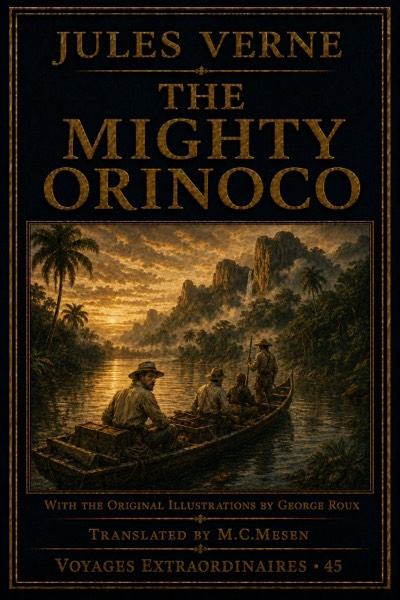
Voyages Extraordinaires · No. 45
The Mighty Orinoco
Published in 1898, The Mighty Orinoco (original French: Le Superbe Orénoque) carries Jules Verne's readers into the heart of the South American continent, where the great river of the title becomes the artery of a journey that is equal parts geographic survey, personal quest, and game of identities. Sergeant Martial, a seasoned and gruff retired soldier, travels up the Orinoco with his young nephew Jean, ostensibly to join a scientific expedition. But from the very first pages, there is a tension beneath the surface — a sense that the voyage conceals a purpose not yet spoken aloud.
The expedition is led by Mr. Miguel, a dedicated scientist whose passion for accurately mapping the river's course and determining its true source provides the expedition with its scholarly veneer. Yet as the party navigates the treacherous currents, dense jungles, and remote settlements that line the Orinoco's banks, it becomes increasingly clear that the scientist's goals and Sergeant Martial's private mission are not perfectly aligned. The river, Verne reminds us, reveals its secrets slowly, and so do its travelers.
Verne lavishes attention on the geography and ethnography of the region, describing the lush vegetation, the indigenous peoples encountered along the way, and the subtle shifts in landscape as the expedition pushes upstream. Captain Valdez, the commander of the river vessel, guides the party with steady competence through rapids and shallows, while the surrounding forest teems with jaguars, monkeys, and birds of dazzling plumage. The river itself — broad, powerful, and untamed — becomes a character in its own right, shaping the rhythm of the narrative.
Beneath the surface of this adventure story lies a carefully constructed revelation about kinship, inheritance, and the unexpected shapes that family can take. Verne blends scientific curiosity with emotional depth, using the journey up the Orinoco as a metaphor for a search that is both outward and inward — a voyage toward the headwaters of the river, and toward the truth that gives the journey its true meaning.