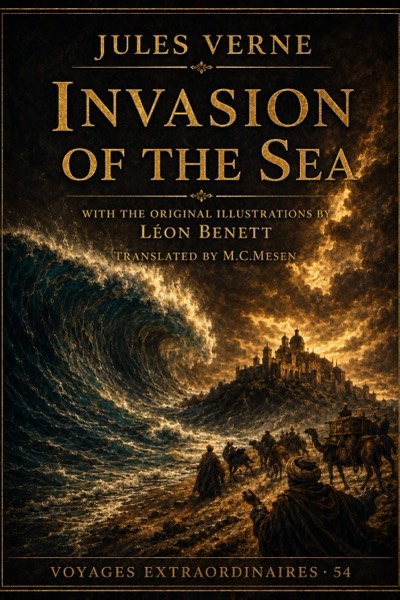
Voyages Extraordinaires · No. 54
Invasion of the Sea
Published in 1905, Invasion of the Sea (original French: L'Invasion de la mer) is Jules Verne's final completed novel, published just before his death — a fitting culmination to a lifetime of imagining the transformation of the world by human will and natural force. The novel envisions an extraordinary engineering project: the flooding of the depressions of the Algerian Sahara to create an inland sea, a scheme that would transform the climate, economy, and geography of North Africa forever.
Captain Hardigan, a French officer stationed in the region, finds himself at the center of the monumental undertaking. Alongside François, the brilliant engineer whose vision drives the project, Hardigan must contend with the immense technical challenges of cutting a channel through the desert and directing the waters of the Mediterranean into the dry basins of the Sahara. The scale of the work is staggering — canals, locks, and barriers stretching across hundreds of miles of unforgiving terrain.
But the engineering is only one dimension of the struggle. Colonel Le Houssaye commands the military forces charged with protecting the project from the Tuareg communities whose ancestral lands are being transformed. Led by the formidable Hadjar, the Tuareg see the invasion of the sea as a violation of their world, a flood that will drown not only their territory but their way of life. The conflict that erupts between the French forces and the Tuareg resistance gives the novel its dramatic tension, a clash between progress and tradition, technology and nature.
Verne, as always, is on the side of human ingenuity — but he does not simplify the moral equation. The Sahara, in his telling, is not an empty space awaiting improvement but a living landscape with its own history and its own people. The invasion of the sea becomes a metaphor for the ambiguous power of civilization to reshape the earth, and the novel asks whether the seas we unleash can ever be contained. It is a visionary work, a fitting finale that looks forward to a world of megaprojects and their unforeseen consequences.