Chapter One. Michel
1
Paris, December 21st, 1:11 p.m.
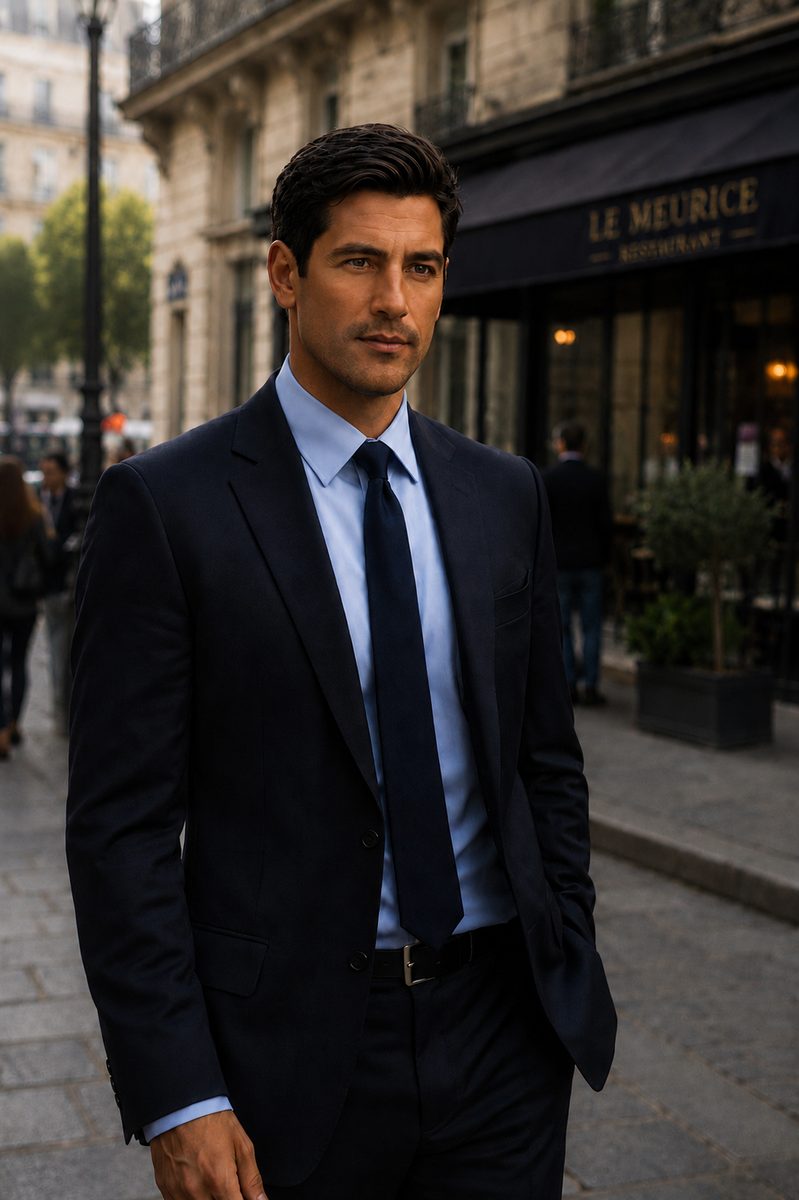
Michel de Nostradamus had never been closer to death than on that cold afternoon, on a narrow side street in Paris’s sixth arrondissement.
Three silent shots.
Skin, viscera, bone—organs pierced all at once.
He felt the metal tear into him, felt his body slam violently against the pavement. He felt everything. Lived everything. As though it were not happening to him, as though he were merely a witness, powerless to intervene.
After the final shot, beneath the euphoric gaze of his assassin’s deranged eyes, he saw a stranger hurl himself at the gunman. All three collapsed at once, and the hitman’s head struck a post with brutal force before smashing against the ground.
Time slowed.
Lying in the middle of the sidewalk—with one bullet in his arm, one in his stomach, another in his chest—blood poured from his body, pooling around him, mixing with the drizzle falling from the sky and with the blood of the attacker lying dead beside him. There was no life in the man’s open eyes; the blow to his skull had been fatal.
Michel saw the wretched soul rise in confusion toward the heavens. Or perhaps he imagined it.
His unknown savior struggled to his feet and looked at them. Terror and despair etched across his face, he did not wait to see whether either man was alive. He turned and ran.
The pain was overwhelming—unlike anything he had ever felt. Michel feared his journey would end there, unfinished. If he did nothing, and quickly, he would bleed out.
He closed his eyes, something he fought desperately to resist. When he opened them again, he had no idea how much time had passed.
Seconds? Minutes?
Time obeys different rules in one’s final moments.
He heard the hands of his Rolex—1931—marking each second with merciless precision, like a countdown to the end, to his omega.
His breathing grew labored, and he felt his soul beginning to loosen, preparing for its brief passage into the other dimension.
No. He could not die like this. He could not end sprawled on a sidewalk.
Lying on the pavement, weak, barely alive, he felt with absurd certainty that this afternoon would not be his omega, for the surge of energy he had felt an hour earlier signaled a new beginning.
It was now or never. Walk one hundred meters—or die.
He gathered what strength remained in his legs and pushed himself upright, one hand clutching his stomach, the other pressed to his chest, blood soaking through his shirt. He lifted his gaze down the street, conspiring with the rain and the cold in its emptiness, and dragged his feet forward—one step, then another—reproaching himself for not having spoken sooner, for not having described his visions, for not having been more explicit.
What use is knowledge if it cannot be spoken?
A masochistic act of self-inflicted torment?
He had written what would happen, but to avoid betraying his predecessors, he used the same veiled, threefold language the Voice itself employed to describe events. And so he failed. He left clues no one understood, despite knowing what was to come. Small things changed—people alter the whole when they chase their destiny—but in the grand design, in what truly mattered, what he had seen came to pass, or something very close to it.
As his visions unfolded one by one, he wandered the world—living, learning, waiting—attentive to signs that might guide him, always ready to intervene if events failed to shift.
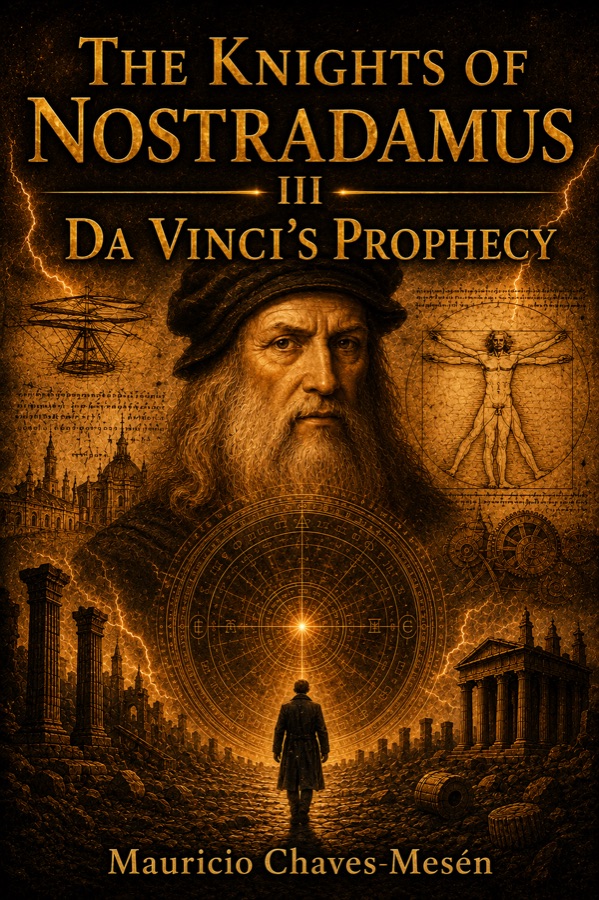
His mission was clear: to confront the horrific vision Leonardo Da Vinci had set down in his thirteenth prophecy—a vision of which Michel himself had caught a glimpse—the most important and terrifying of all, because beyond it, there was nothing left to see.
This time, he would not remain a mere spectator to the end, as the writings commanded. He would do something radical. He did not know whether he would succeed, but he wanted the chance to try.
Fifty steps.
Forty.
Thirty.
Twenty.
Ten.
He knocked on the door.
A face he had not seen in centuries appeared.
Collapsing into his arms, Michel babbled, struggling to explain a moment that made no sense.
“Francesco… They’ve discovered us… The apocalypse has begun… We must stop the end of the world…”
2
December 21st is a palindrome of profound significance. Its central numbers, when mirrored against one another, form omega:
Ω
1 2 2 1
Alpha – omega – alpha
Beginning – end – beginning
The alpha and the omega that encapsulate the history of the world and of life itself, and which cause humanity, on that day, to enter a special frequency—one that allows people to feel the hope of rebirth and the illusion of a new opportunity.
Michel de Nostradamus, whose life had always revolved around numbers and symbols, was well aware of its other, esoteric meaning: it is the date of the seventh initiation of humankind, the final step on the initiatory path, in which the enlightened transcend their humanity.
Centuries earlier, his masters had taught him how to enter a deep trance, how to wait for illumination—the elusive cosmic consciousness described by Richard Maurice Bucke, which has allowed certain extraordinary beings throughout history to glimpse the truths of the cosmos. Year after year, Michel sought to reach it.
The closest he had ever come to enlightenment occurred in 2012, following the opening of the portal described by the Maya and other cultures, when the energy of the universe flowed toward Earth as it had not in twenty-five thousand years.
The door opens, the whole flows in calm, the cosmos awaits us in its arms.
Thus the first verse of the thirteenth prophecy was fulfilled—the first sign announcing the nearness of a great omega and a great alpha, inviting one to feel the gentle breeze that precedes the storm.
After his recent and tragic experience with the Circle of Power, his prophetic gift had returned, after years buried deep within his psyche. It could not be coincidence; it felt instead like a sign, a guiding beacon announcing the proximity of that destiny.
That day began like all the others, with the reading of Le Figaro, the newspaper he had witnessed being founded two centuries earlier and for which some of his friends had written—Émile Zola among them. He had never abandoned the habit of reading it each morning, even knowing the news would be much the same as always. The world changes little, evolves little, despite how much it appears to change on the surface. Different actors, different stages, but the same emotions: the seven P’s—power, privilege, passions, prejudices, persecutions, protests, paranoia—and the wars, suffering, and injustices caught in between.
At the exact hour of the solstice—which that year coincided with the 21st—he closed his eyes.
Three, two, one—and he shifted.
For him, entering trance was that simple. Centuries of practice allowed him to disconnect from reality and take refuge in the folds of a psyche already connected to the whole.
In his mind, the dystopian images of the cursed future paraded in an endless loop; now, what had once been blurred grew sharp, as though the future itself were pressing toward the present.
Hours passed like this, while time—within that trance—held neither meaning nor measure.
He opened his eyes.
That was when he saw the pendulum.
With its slow yet inexorable rhythm, the infinite pendulum—whose motion had accompanied his days for hundreds of years—marked twelve eleven in Paris, and a wave of energy, immense and overwhelming, shook the planet.
He allowed himself to feel it.
He absorbed the crushing energy that enveloped him like a mantle, seeping in through his pores. His cells reacted to the invigorating force, becoming saturated with goodness and benevolence. It was beautiful, pleasurable, and Michel could not suppress a smile. The long-awaited something foretold in the second verse of the thirteenth prophecy had just illuminated the world.
“The great celestial light.”
For a brief moment, he believed that enlightenment had finally arrived—but just as quickly as it came, the ecstasy dissolved into the ether, leaving him without cosmic consciousness. Neither time nor space came to a permanent halt, and he was himself once more.
And then, with mounting unease, he remembered that this second sign marked the nearness of the two possible outcomes for humanity: a great positive transformation—or a horrifying, repulsive end.
Both possibilities lay on the table.
After what he had felt, the future became harder to comprehend.
Why—if it began like this, in ecstasy—could it end so terribly?
Continue in the full book →
amazon.com · amazon.co.uk