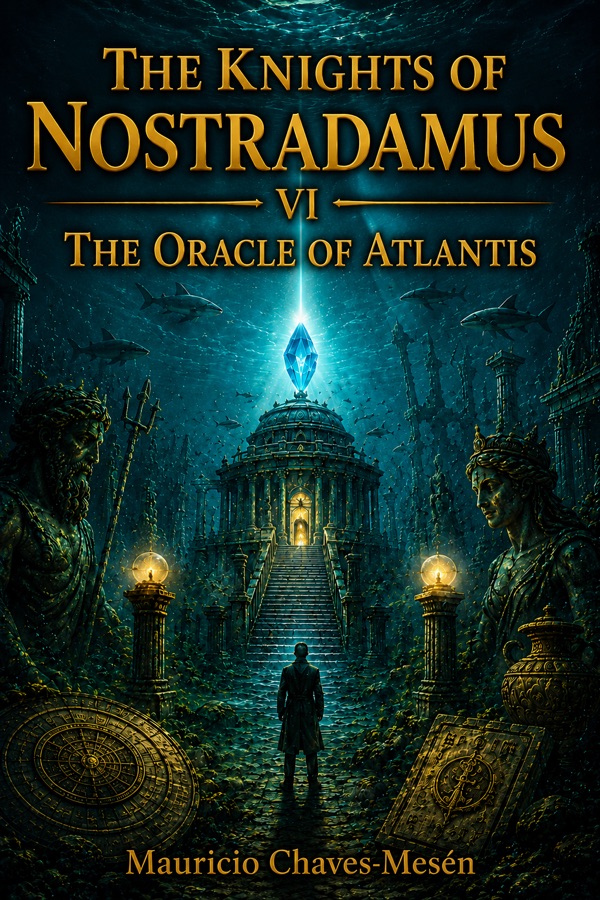
The Knights of Nostradamus · No. 6
Oracle
The Oracle of Atlantis: an ancient prophecy that could save or destroy humanity — and the Knights are the only ones who can decipher it.
4.8 stars globally · reviews from real readers
The Knights of Nostradamus · No. 6
The Oracle of Atlantis: an ancient prophecy that could save or destroy humanity — and the Knights are the only ones who can decipher it.
4.8 stars globally · reviews from real readers
Main characters

Vida Jiménez
Doctor in Theology, Archaeology and Sociology, master in Art and Architecture, accomplished painter. She started university at age 15. Specialist in ancient languages and early centuries of Christianity. She gets involved with Senator Gordon in an investigation about giants and a mysterious artifact.
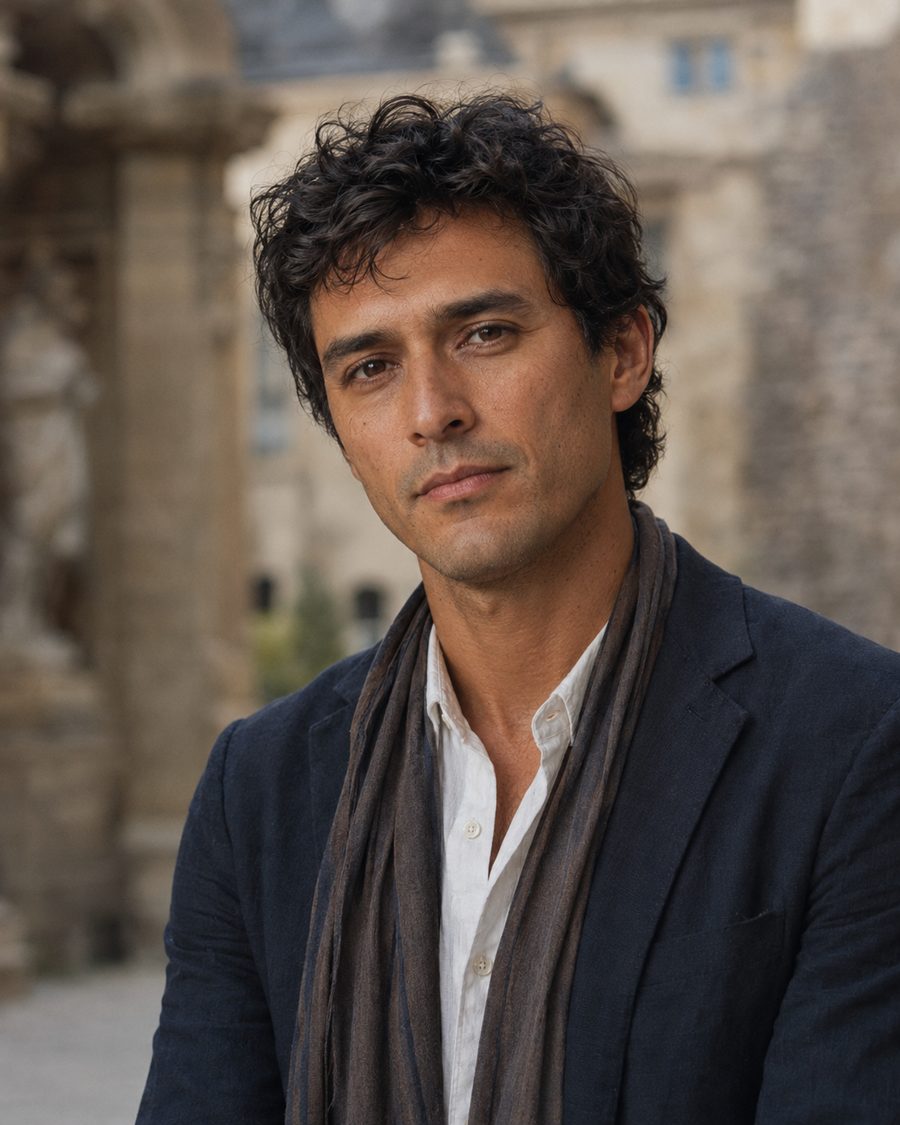
Hans Andersen III
Visiting professor at George Washington University, expert in Inca culture and connections between ancient civilizations using AI. He holds doctorates from Yale, Oxford and Bologna. He is the author of several books. He believes in reincarnation. He is heading to an esoteric congress in Bologna.

Alexander Gordon
Senator from Maryland, presidential candidate, heir to an ancient family that secretly controls the world. Studied Law at Georgetown, doctorate in Political Science at Harvard and Economics at Oxford. Widower, father of 18-year-old twins. Recruits Vida.
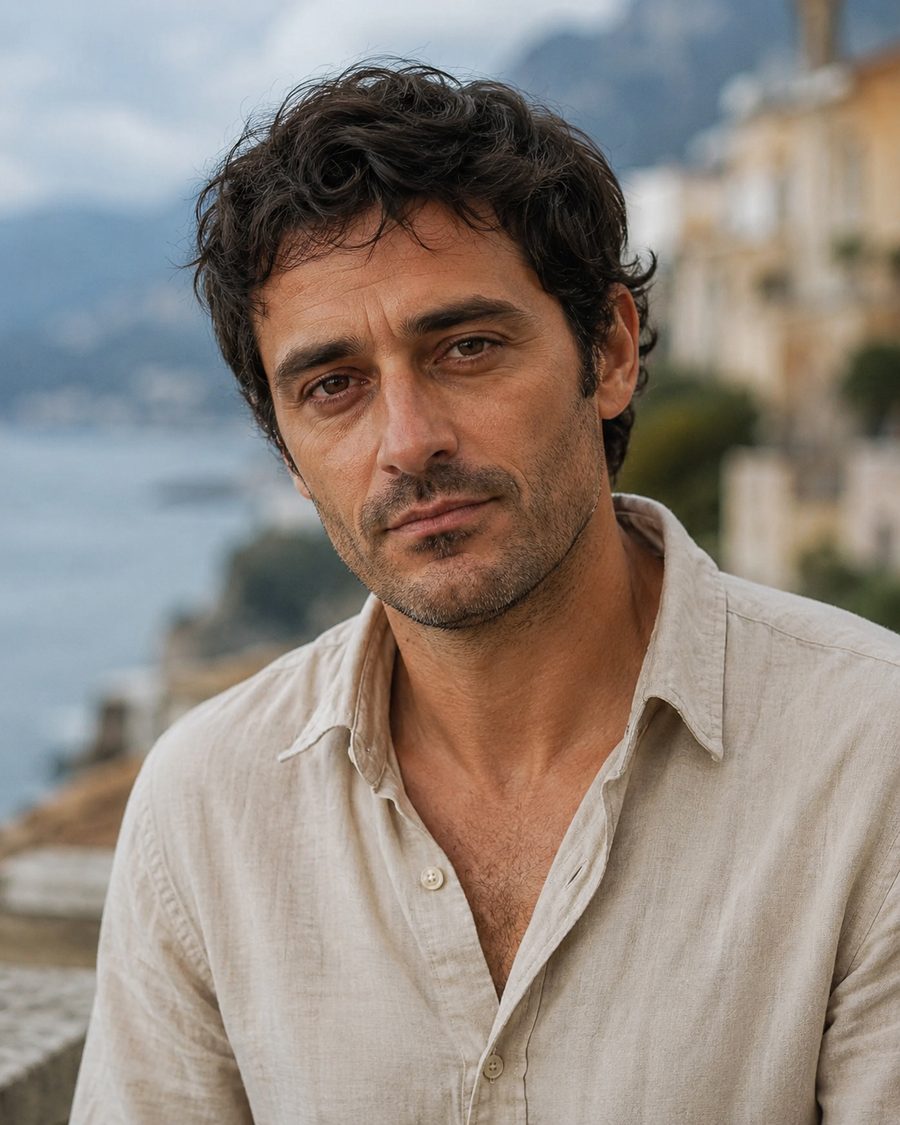
Antonio Vivaldi
Finds a manuscript by Verne, but keeps it for many years until life leads him to get involved with Marilyn Jones and the mysteries of Atlantis. He descends from a brother of Antonio Vivaldi, the Italian musician.

Marilyn Jones
Marilyn Jones is a wealthy heiress who has used her fortune to explore the seas in search of Atlantis aboard a ship called the Nautilus, usually accompanied by her sister Veronica. She is the daughter of Robert (Bob) Montgomery Jones and Ada Monrose-Jones.

Verónica Jones
A wealthy heiress who has used her fortune to do whatever she pleases. She now explores the seas in search of Atlantis aboard a ship called the Nautilus, accompanying her sister Marilyn. She is the daughter of Robert (Bob) Montgomery Jones and Ada Monrose-Jones. She is more than she seems...
Author's Favorite
The author’s favorite part of this novel:
The description of the Vivaldi vineyard and the grandfather’s special relationship with the vines.
And, of course, Atlantis!
Read First Pages
Prologue
Washington, D.C., December 22, 7:30 a.m., GMT-5
There was a sense of urgency in the movement of her lower limbs. Dr. Vida Jiménez pushed through the crowd with a serious face, her legs devouring distance, climbing and descending stairs without a second thought. She tried to move fast, but not so fast that she exceeded what her body could handle. She had to get to New York.
What the hell did you get me into, Alexander?, she wondered, forcing herself to keep going while lugging an enormous teddy bear—almost as big as she was—whose weight was hard to manage because of the treasure hidden in its belly: a pyramid-shaped artifact she had just stolen from the Smithsonian Institution.
She tried to assess the significance, the possible consequences of her discovery—or of what she’d done—but got nowhere, because she had no idea what the plot she’d stumbled into actually meant.
She took the Blue Line at Smithsonian Station, and when she reached Metro Center she got off. She bought a backpack at a shop, went into a restroom, pulled out the treasure, got rid of the teddy bear, and took the Red Line to Union Station.
Feeling watched—though not sure by whom, or whether the fears sparked by her paranoia were even possible—she bought a ticket in cash for the next train to New York.
When she finally sat down in the third first-class car, the emptiest one she could find, she tried to breathe deeply and calm her body’s nervous system, which was firing off all its synapses.
Inhale, exhale, inhale, exhale…
She almost broke into tears, but using the techniques she’d learned in jiu-jitsu, she managed to control the surge by recalling everything she’d accomplished in a life that had prepared her for this exact moment.
Vida Jiménez was a strong, beautiful, single, independent woman, with an IQ that put her in the genius range. Fifteen years earlier, as a teenager, she had started university in pursuit of her dream.
I want to travel and do interesting things; I’m not asking for much, she used to tell herself, and that had been her main requirement when choosing a career.
From a very young age she developed a deep passion for ancient languages. Something drew her to cuneiform characters, to hieroglyphs, to those simple scribbles and drawings human beings have tried throughout history to convey a message and make their ideas known. To her, they made sense—she recognized patterns even without having studied them—so she sought out fields that had a symbiotic relationship with them, and devoted the next ten years to studying.
Since learning everything came naturally to her, she was the best in every course she took, and the shy teenager became a wildly successful PhD in Theology, Archaeology, and Sociology; a master’s degree holder in Art and Architecture; and, on top of it all, an accomplished painter.
That was who she had been five weeks earlier, before Senator Alexander Gordon, one of the most powerful men in the United States, offered her work on a project at the Smithsonian.
Over the last twenty-four hours, her career had taken a dramatic turn after the appearance of the artifact now sitting in her backpack.
What happened next had been unexpected, and it was becoming dangerous. The only person she trusted was waiting for her in New York. He was a powerful man, he was her friend, and he could protect her if necessary.
Meeting him had become urgent.
1
Washington, D.C., November 15
Senator Alexander Gordon sat in the last row of the auditorium and listened as the lecturer described life in the early centuries after Christ, when an early cult—a splinter of the Jewish tradition—began to transform into the religion that would come to dominate the modern world.
That was the subject of Dr. Vida Jiménez’s latest book. She was a widely admired author on these matters, the kind of mind that not only possessed the intelligence required to stand at the forefront of her field, but also the passion and empathy needed to share her experiences. And she did so with anyone curious enough to read her books or attend her lectures.
To Gordon, it was clear that the reasons the auditorium was filled with a predominantly male audience went beyond the fact that her book was fascinating—as were the four before it—or the speaker’s evident erudition, which carried the audience back to those early centuries, guiding them through the streets of Jerusalem and Rome, allowing them to almost see and touch her characters.
Vida was also a very attractive woman. Not merely attractive; she was extremely beautiful. Straight, long black hair; delicate yet strong features; dark eyes that, when caught by the light, seemed to reflect a kind of magic; a slender yet voluptuous body in a perfect contradiction—all of it combined with a melodious voice, a contagious charm, and the undeniable fact that her talks were immensely engaging, made her a pleasure to the senses.
But Gordon was not there to admire her beauty.
Her résumé, her books, and her lectures had convinced him: she was the one: the person who would help him betray the families and everything he had, until very recently, followed blindly.
The lecture ended, and the auditorium emptied out except for a group of attendees eager to take selfies with the author. After the process—which was anything but swift—and once the last satisfied admirer had moved on, the Senator, who had been waiting in the front rows, approached her.
“Good afternoon, Dr. Jiménez, my name is—”
“Senator Alexander Gordon.”
“I was going to say just Alexander, but I’m flattered you know who I am.”
“You spent a fortune on campaign ads for your reelection. I imagine many people in this auditorium could recognize your face in a crowd. It’s a pleasure to meet you in person.”
“The pleasure is all mine, Doctor.”
“So,” she said, referring to the subject of her book, still surprised that someone so important had come to see her, “are you interested in early Christianity, Senator?”
“You’ve convinced me they were fascinating times, and that what happened then shaped the next two thousand years,” Gordon replied, having listened closely to the lecture.
“Indeed.”
“Doctor, the reason I’m here isn’t a social one. I read your latest book, I liked it, and I’d like to retain your services for a special consultation.”
“A special consultation?”
“You’re an expert in many fields; I need help with a particular matter.”
“And what kind of matter could involve a senator, be related to the early centuries of Christianity, and motivate you to attend all three of my lectures?”
With that remark, she made it clear she had noticed his presence on the previous days. It had been hard not to, considering he was accompanied by at least a dozen male and female security agents, blending in with the audience and appearing harmless, though Vida could spot them from a mile away.
“Doctor, if you have time now, I’d like you to accompany me to my home. I live about half an hour from here, in Maryland, and my driver can take us there and bring you back. We can discuss the matter there. I’ll pay whatever fee you set.”
“Money isn’t my concern,” she said, “but your request is unusual. Is this a covert CIA or government operation, and am I going to disappear after telling you what you want to know?” she asked, half serious, half in jest.
The Senator attempted something resembling a smile, but since he wasn’t particularly inclined to exercise those facial muscles, what emerged was an odd grimace.
“That only happens in movies… and in Republican governments,” the Senator said.
Vida didn’t find the comment amusing. He went on.
“This isn’t a government matter, and I don’t work with the CIA. The consultation is personal. I did my research, I read your book, I observed you this week, and I decided you’re the person to consult.”
“What is it about?”
“I’d have to show you at my house. I suggest you call anyone you like and let them know where you’re going, and that we take a selfie so you can send it to them. I ask that you not be afraid… I’m not in the business of kidnapping renowned experts.”
This time, the smile came through a bit more clearly, and that eased her somewhat.
“All right, Senator,” she said. “Let’s go; but I’ll follow you in my own car.”
The reason Vida wanted to drive her own car was so she could Google everything she could about the Senator.
Know the facts; know your enemy; be prepared.
She couldn’t remember whether the words were Lao-tzu, Machiavelli, or Dr. Phil—she’d read books by all three—but she used them as a mantra, and they always worked.
She lived and worked in Washington, D.C., but as a matter of principle she made a habit of not trusting politicians and not associating with them. Something about the intrinsic falseness of the profession—saying one thing while negotiating the opposite under the table, offering promises that neither could nor were ever meant to be kept, all while playing with people’s hopes—filled her with an unbearable sense of disgust.
But Google turned up nothing negative about the Senator. He was a powerful man—far more powerful than she had imagined—but his personal life was spotless. He had graduated summa cum laude from Georgetown Law and earned a PhD in Economics from Oxford at the age of twenty-three, ranking first in his class at both institutions. Married to his high school sweetheart, who had died during the COVID-19 pandemic due to a high-risk medical condition (according to Wikipedia). Gordon blamed himself; he had brought the virus home after being infected in the Senate by a denier. Father of eighteen-year-old twins, a boy and a girl, exemplary students attending Stanford on the other side of the country. Two Neapolitan Mastiff dogs with dark brown coats, Sparkles and Dino, whom he referred to as “my friends, not my pets.” No scandals. No dirt. He hadn’t been caught smoking marijuana at seventeen, nor wearing a costume that thirty years later some immaculate purist would label inappropriate on Twitter/X.
His positions on every issue were centrist, thoughtful—one might even say fair—and at forty-three he was considered the most prominent senator and the most respected by both sides of the chamber, an almost impossible achievement.
After fifteen minutes of DWG—driving while googling—something made easier by the autopilot of her Tesla, her honest conclusion was that the man was impressive, and that he would soon become president, as rumors suggested he would be his party’s nominee in the upcoming election.
I’d even vote for him, she thought, as she made the call the Senator had suggested.
“Hello,” came the voice on the other end of the line: Norah Barker, her best friend, her sister from another mother, a criminal defense attorney who had graduated from Georgetown, so good at what she did that by thirty-three she was already a partner at one of the most prominent law firms in the U.S. capital. They had grown up in neighboring houses since the age of five—they were the same age when they moved there—in Eastchester, New York, an upper–middle-class town about forty minutes from Manhattan.
“Norita!” Vida said affectionately. “You’re not going to believe this!”
“At last you’re going to work less and actually live your life! Yayyy!”
“Ha! You’re hila-ri-ous—look who’s talking,” Vida said sarcastically, yet genuinely happy to chat for a moment with her friend. “But this really is important.”
“I’m listening.”
“I’m on my way to Alexander Gordon’s house—the Senator.”
“The Senate appropriations guy?”
“Yes, that one. He wants me to review a document or something like that. I know, right? It sounds… interesting.”
“Yes—but also dangerous.”
“That’s why I’m calling, so that in case you never hear from me again and my body never turns up, you’ll know who the murderer is.”
“The butler!”
They both laughed.
“Seriously, though, be careful,” Norah said. “You never know with politicians.”
“I know. I can’t stand these guys and their entourages, but this Gordon doesn’t seem like a bad person. I don’t think he’s planning to kidnap me.”
“We’ve seen enough movies to know it’s a possibility.”
“True. I should’ve taken the selfie he offered… just in case, for evidence.”
Norah wasn’t sure whether to laugh; she couldn’t tell if Vida was joking.
“Okaaay…”
“I’m kidding—but just in case, now you know where I am. I’ve got to go, we just arrived.”
As promised, the drive took exactly half an hour. The Senator’s home was a mansion set on twenty acres of land, with multiple floors and an absurd number of rooms, enough to rival, and even surpass, some great medieval castles. To all appearances, Gordon lived alone in that house—mansion, castle, palace—a space large enough to accommodate twenty families. Vida couldn’t understand this sort of thing. It wasn’t about socialism or capitalism; she simply wondered what people who chose to live in a castle like this felt the need to prove—and to whom. Arrogance, she believed, was the opposite pole of self-assurance.
They parked in front of the main entrance. Gordon got out of his car and walked over to meet her.
“I hear Teslas handle beautifully. I’ve never tried one,” the Senator said, admiring her car.
“You should! Everything they say is true, they’re fantastic. The problem is the autopilot is so good you forget you still need to pay attention to the road. If you like, you can take this one for a spin later.”
The Senator smiled—this time the smile was complete—thanked her, and gestured toward the entrance of the house.
“After you, please.”
“Thank you.”
The foyer opened into a vast hall filled with art. Paintings hung on the walls, works she believed belonged in museums. Or were they copies? Monet, Manet, Degas, Cézanne… She recognized them instantly; one of her graduate theses had been on Impressionism.
“Are they originals?” Vida asked, though she already knew the answer.
“My great-grandfather did business in Paris at the beginning of the last century, and he had a great love for art. Back then, these works didn’t cost fortunes. Some painters couldn’t even find buyers for their pieces… like this one…”
Gordon walked to a corner of the hall and pointed to a painting.
“Van Gogh? I recognize the style, but not the piece,” Vida said.
“Vincent van Gogh sold only two paintings in his lifetime, both just months before his death. One for four hundred francs—the one everyone knows—and this one, for which my ancestor paid six hundred, recognizing a genius no one else saw.”
“It’s not listed in any catalogue.”
“No. My family has refused to allow it to be catalogued, and since so much of the art world depends on other branches of my family, our wishes have been respected. It’s the only piece that never leaves this wall. The others I lend to museums for short exhibitions, though I’ll admit I’m more at ease when they’re here. But these weren’t the paintings I wanted to show you,” he said, leading her into another hall, even larger than the first, whose walls were lined with Spanish art. Dalí, Picasso, Joan Miró… Paintings valued in the tens of millions. Making another comment—or questioning whether they were originals—would have been superfluous.
On an intricately carved wooden table, visibly ancient, rested a specialized vacuum-sealed case. Gordon motioned for her to look. Vida stepped closer to the box, which encased a painting no more than a meter wide and a meter tall.
“May I?” she asked, suggesting that the protective casing be removed so she could examine it more closely.
Gordon nodded and opened the box with a special key.
Vida didn’t take the painting out; she simply studied it more carefully without the barrier of glass. She knew the subject matter. The same scene had appeared twice before, both times linked to the origins of Christianity: once on a first-century canvas discovered in Israel, and again in a mural in Hagia Sophia in Istanbul, painted in the year 360 on a wall of the original church that had survived subsequent reconstructions. In her latest book she had tried—unsuccessfully—to resolve the mystery of those paintings; there were loose ends she had never been able to tie together.
Gordon’s painting was identical in design, color, texture, and technique to the one from Israel, and similar in design to the one in Istanbul. But in a small panel in the lower right corner, each cited a different part of the same verse from the Greek Bible.
The Israeli painting read: Ask and it will be given to you. The Hagia Sophia mural: Seek and you will find. On Gordon’s painting, the inscription read: Knock and the door will be opened to you.
“Some colleagues unearthed a very similar painting in Israel a few years ago,” she said, never taking her eyes off it.
“I know.”
“And there’s a third one in Istanbul…”
“I know that too. I’ve read your book,” Gordon said.
He paused, studied her carefully—he prided himself on being a good judge of character—made a decision, and added:
“Dr. Jiménez, how good are you at keeping secrets?”
The Senator excused himself for a moment. When he returned to the hall, he was carrying a document. A non-disclosure agreement.
“Is this really necessary?” Vida asked. She disliked long, generic contracts, deliberately designed so no one would bother reading them.
The Senator remained impassive. He was an enigmatic man—capable of being pleasant, but also unsettling—and Vida found it difficult to tell which was his true nature. Then again, wasn’t that the very definition of a politician?
“Yes, it’s necessary. What I’m about to reveal to you is so serious, so profound, that if you don’t remain silent it could alter the course of history. The agreement isn’t for me; it’s for you. Clause twelve guarantees that as long as you keep your mouth shut, no one will act against you.”
Vida stopped liking the Senator. His tone had turned aggressive, utterly different from before. He had threatened her, not subtly: speak, and there would be consequences. She chose to think before reacting.
This is personal for Gordon. Whatever he wants to reveal matters deeply to him; therefore, he protects it with aggression. And he’s successfully piqued my curiosity.
As for the implied threats, she remembered her martial arts instructor, Master Yao. Show them you’re not afraid. Show them you’re stronger. He had been talking about physical confrontations, but the wisdom applied just as well to mental ones.
With deliberate calm, she reached into her purse and took out a Montblanc pen. She signed the agreement without reading it—otherwise they’d be there all day—and, lifting her eyes in a defiant gesture, made it clear she was ready.
“Shall we?” she said.
Gordon took the carefully detailed document, placed it in a safe beside his desk, and guided her to an elevator concealed behind an unassuming door in yet another art-filled room. To activate it, he used a retinal scanner, then pressed –3, even though the panel indicated six subterranean levels.
The mansion was larger below ground than above it.
What is this senator hiding? Vida wondered as she descended many meters underground.
When the doors opened, they stepped into a corridor whose walls were made of white panels, roughly four meters wide and three meters high. They walked until they reached the one marked with the number 70.
Gordon placed his hand on a palm scanner beside the number, and the panel lifted, revealing a room eight meters deep. Inside, laid out on a large worktable, was a skeleton. It appeared human, except it was enormous. Vida estimated it measured over three meters tall.
Without saying a word, without even an exclamation of surprise, she hurried to its mouth and examined the jaw.
“Two rows of teeth,” she murmured clinically.
She then checked the bones of the hands and feet, confirmed that they had six fingers instead of five, and finally smiled, like a child discovering that Santa Claus really exists. Gordon found it amusing, in his own way, that such a childlike smile was her reaction. After all, he was revealing the body of a giant to her, one of science’s worst-kept secrets.
“I always knew it was true,” Vida said in an academic tone. “I just lacked the proof.”
“What do you mean?”
“Native American tribes tell stories of having defeated hordes of giants thousands of years ago; and there have always been rumors that about a hundred and fifty years ago, dozens of skeletons like this were unearthed in West Virginia. Apparently, the Smithsonian Institution collected them and disposed of them, later denying they had ever existed.”
“All three are true, Doctor. In the late 1800s there was little interest in challenging the narrative accepted by science. So when the West Virginia skeletons appeared, the Smithsonian collected them, loaded them onto barges, and dumped them into the ocean. The giants were a large, organized community, and the operation was far bigger than history admits: there were hundreds of skeletons.”
“What’s your source?”
“My ancestor was part of the Smithsonian expeditions. This giant was excavated from the Criel Mound, in South Charleston, during Colonel Lewis Morris’s mission. The legends recorded at the time said that the giants, after being hunted and persecuted for millennia by Native Americans, eventually surrendered and stopped fighting. Buried in the mound were the last kings, before the entire race was massacred.”
Vida did not dare interrupt. If Gordon’s story was headed where she thought it was, she was standing beside an epic giant king.
“Seven bodies were found: the king, the queen, and their five children. It’s unknown whether they died together or at different times, but what is known is that they were buried with artifacts and tablets written in a language unlike any known.”
He paused, certain that what came next would provoke a reaction.
“The painting you saw upstairs was also found.”
“In North America?” Vida asked, questioning the veracity of the impossible story being told to her. “Your painting is from second-century Israel… how could it have appeared in a thousand-year-old giant’s tomb?”
“Believe me, I’d like to know that myself.”
“Mr. Gordon, you have my full attention. You said you wanted to consult my professional opinion on something specific.”
“That’s right. But the proposal is somewhat complicated. Shall we go up to my study?”
Continue in the full book →
amazon.com · amazon.co.uk