PROLOGUE
Verona, Italy — July 13
The explosions threw him to the ground.
The groan of twisting steel and the crash of concrete collapsing above him sounded like trumpets of the apocalypse.
Instinctively, he shielded himself from the rain of debris.
The world turned white, then red… and then… nothing.
He opened his eyes into a universe of dust, darkness all around, his ears ringing. He coughed, his throat dry, choking…
He moved.
Alive.
No, he corrected himself, I’m not alive… I’m a survivor… And survivors… have to survive…
The ringing disoriented him. He tried to remove his jacket and nearly blacked out from the pain. Blood was flowing from his side, a serious wound.
He took a moment to steady himself. No vital organ seemed pierced—but if he didn’t move, he would die.
He made a mental inventory, retracing the night up to that point, trying to understand what had happened.
He remembered pleasant conversation, lighthearted tones, extraordinary wines, single-malt whiskies, cigars of the finest tobacco.
The last normal gathering for some time.
In two days, they would be at the head of the world, or what remained of it.
The Circle of Power.
The new order.
What followed had been unexpected. Gunfire from upper levels, artillery strikes, soldiers running frantically. They were under attack, fighting to the death.
The members of the Circle and their guests began to evacuate, heading toward the escape tunnel two levels below. In the chaos, they found General Di Marco–Bevilaqua forcing open the doors of the hall where Count Giancarlo Rocca di Rossi was staying.
“Giancarlo!” he shouted, certain the general had betrayed them and was attacking their leader.
He drew his weapon and ran after Di Marco.
He was crossing the threshold when everything collapsed.
Still in shock, he covered his mouth and nose, inhaled and exhaled three times. With the third breath, he triggered the adrenaline.
He braced himself against the doorframe, pulled his phone from his pocket, and searched for a signal: impossible in a subterranean bunker beneath tons of concrete… threatening to crush him and become his tomb.
Thirty or forty meters from his position lay the escape tunnel. He illuminated it with his phone’s flashlight. Collapsed—except for narrow gaps between columns, with no way of knowing if a path still existed.
To the right, in the distance, he saw Giancarlo’s desk.
He wondered if he had survived. The absolute silence was not a good sign. He chose not to call his name, in case General Di Marco was still alive and intended to complete his betrayal.
His only option was the tunnel.
A distant groan reached him—someone badly wounded. He tried to rise. The pain was so intense he let out a growl.
A beam of light struck him.
“Sir?” someone called.
He hesitated, but he needed help.
“Who are you?” he asked, gripping his weapon.
“Luciano Perugino. Son of Count Pietro.”
One of ours for generations, he thought.
But in times like these… how much was inherited loyalty worth?
“I’m injured. Survivors?” he asked, still wary.
“A couple were groaning a while ago… I don’t hear them anymore.”
A while ago?
He checked his watch. 12:22. His mind had been drifting in and out of limbo for half an hour.
His head throbbed like hell. He touched it. A brutal blow. Another roar of pain escaped him.
“Ahhhhgggg!”
Everything was buried under rubble, except for narrow openings through which Perugino’s flashlight cut.
“I see crushed bodies… no one’s responding… I can see you, but I can’t reach you. There are beams blocking the way. Do you see that desk ahead? Do you think you can make it?” the young man said, shining the light in that direction.
“I’ll try.”
Another roar.
“Come on. I’ll meet you there! Come on, sir!”
They made it. The desk’s thick, solid wood still held, despite the beams threatening to crush it.
“Sir…” Perugino said, illuminating the floor beneath it.
In a pool of blood lay a woman, gunshot wounds to the chest, right side, and arm.
He checked her pulse. Faint—but there.
“Sir…”
Perugino shifted the light to another body nearby.
“Porca miseria!” he exclaimed upon seeing Giancarlo Rocca di Rossi—the anointed—or what remained of his torso beneath a ton of debris.
He smiled when he saw the body of the traitor, Di Marco–Bevilaqua, the heir to two of Europe’s most noble families… the man who, at a dinner in his home, had sworn eternal loyalty while looking him in the eye.
He had betrayed the Circle of Power. Now he lay in pieces.
Divine justice.
With immense effort, and through groans of pain that threatened to drive him mad, they dragged the woman’s body through narrow, precarious gaps between tangled columns that would not hold much longer. Every time one creaked, they had seconds, not minutes.
“It’s giving way!” Perugino shouted as a concrete pillar began to tilt.
“Move!” he roared, pulling the body as tons of debris collapsed behind them.
They reached the entrance to the tunnel.
He couldn’t bear the pain any longer—he blacked out.
Darkness. Then—voices.
He woke an hour later in a room inside the safehouse on the outskirts of the base, surrounded by anxious faces.
After carrying the woman through the tunnel, Perugino had returned for him with two others.
“What time is it?” he asked.
“Two twenty-seven,” someone replied.
Almost three hours since the explosions. Outside, the search for survivors and bodies had already begun… along with the investigations that would change everything.
He needed to initiate containment, and do it now.
The ultra-secret Site Eighteen, built to coordinate the fight against radical terrorism and the threat of Chinese and Russian forces, was in reality the headquarters of the Circle of Power.
Access to the lower levels (–5 to –7) required the highest security clearance: people bought with vast sums of money, because causes and ideologies had long since ceased to be enough.
No one questioned what happened there, who came, or how they entered.
Under the cover of the facility, millions had been invested in a tunnel stretching hundreds of meters, leading to a safehouse in Affi, a nearby town, giving them freedom of movement.
Through it, the survivors escaped and took refuge.
The rest were dead.
“There are several injured… they’re in bad shape. I don’t think they’ll make it,” reported Marquis Albiani, a respected member of the Circle. “Nikola is a doctor. He’s stopped the bleeding, but… we can’t leave here until things settle down. Outside, it’s chaos.”
“Nonsense, we need to get them to a hospital.”
“And if there are more traitors? What if Di Marco has accomplices? What if this house is no longer safe?”
Albiani had just voiced the same doubts running through his mind.
General Di Marco? He would have suspected many, but not him. Yet they had all seen him forcing open the doors and firing, moments before the world collapsed over Giancarlo and his daughter.
“And Perugino?”
“In the main hall. You owe him your life.”
“And I will repay him. Is he loyal?”
“Complete trust. He’s Pietro’s son.”
“And Di Marco was Antonio’s son… and look how that turned out.”
“Yes. We’ve lost too many. We’re finished.”
“Not while they—and I—are still alive. They need treatment immediately,” he said, pointing to two of the severely wounded women.
Without another word, he called a distant cousin, Dr. Ercole Mazzetti.
A short while later, an unmarked van carried the wounded away from Verona.
From the rear window, he watched smoke rising from the NATO base: what had taken years to build, destroyed in minutes.
Not just the concrete, but their order, their illusion of control—their world. A world in which Giancarlo Rocca di Rossi—crushed beneath the beams—had been the chosen one, according to four prophecies of Nostradamus.
In the months that followed, he would come to understand that Nostradamus had not been wrong, he had been misinterpreted.
Now it was clear.
The true chosen one… was him.
Marquis Stéfano Sergó Farinari–Bevilvino.
Chapter One. Ron Reagan
1
Washington, D.C., November 22.
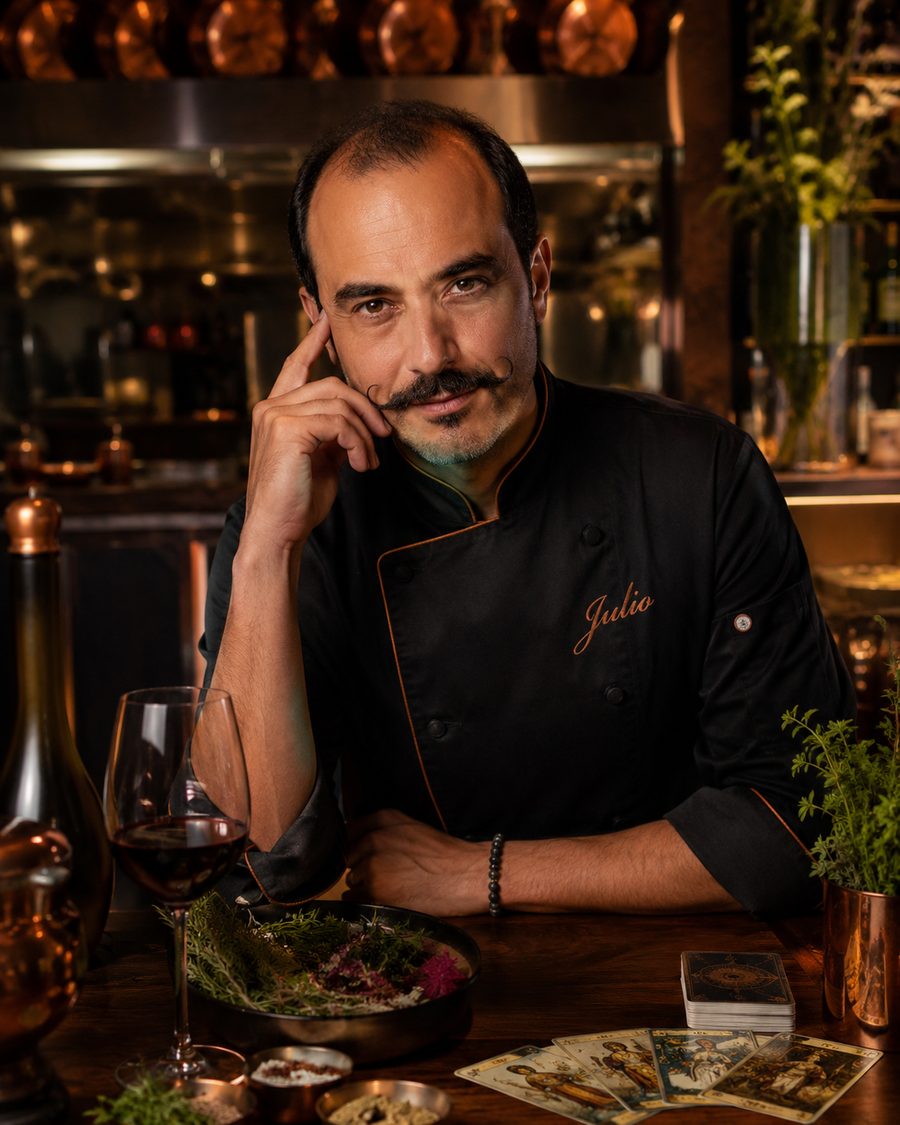
The rice was lukewarm when Julio tipped it onto the mat. With hands damp with water and vinegar, he spread it with the precision that years and affection give. The nori seaweed sheet crackled as it received the white weight.
“It’s not about covering everything,” he said, showing his students. “Always leave a free edge.”
He stopped, watching their attentive faces.
“Sushi is balance, not excess. And balance… is when the human meets the divine without so much as brushing against it.”
The Japanese knife rested to one side; the salmon, cut into thin strips, gave off a briny aroma.
“The rice is earth… it sustains us,” he explained. “The fish is water; it reminds us where we come from. The wasabi, fire, awakens what was sleeping. And the air… the air is provided by you. Breathe as you roll.”
The students laughed, thinking it was a joke. Julio did not smile; he took his art and his passion seriously. He took a deep breath, placed the salmon delicately, and began to roll the mat.
“The secret isn’t in squeezing,” he continued, “but in listening. The seaweed will tell you when to yield, the rice when to compact.”
The others tried to imitate him, clumsy and noisy.
With patience, he gave each one the final instruction on how to do what he loved, as if he wanted to pass on to them the ancestral art learned from his masters in Japan in a summer twelve years ago.
For Julio, cooking was an art. It rose from deep within him. He loved combining flavors and uncovering the stories behind each dish. His secret lay in the herbs and in the details: when to flambé, when to season, when to fry. The garlic here, the onion there, delicate drops of oil, pinches of spices… That was how the magic began.”
When it was time to cut the roll, the blade came down cleanly, as if it were floating. He cut it into eight pieces.
“Eight is structure, but it’s also abundance, because it is the symbol of infinity… that’s why it’s not five or seven or ten: it’s eight pieces,” he spoke as though unveiling a hidden truth. This was more than kitchen philosophy; it was the structure of the universe explained in eight pieces of maki.
Today he did not feel like giving a more detailed explanation.
He placed his plate in the center of the table.
“You will eat from mine first. But don’t just taste, feel. Sushi is not food; it is a mirror that will tell you whether you are calm or at war, whether you are in a hurry or whether you know how to wait.”
Amid nervous laughter the diners took the chopsticks and tasted. The sweetness of the vinegar, the freshness of the fish, the crisp resistance of the seaweed: everything seemed more intense than expected.
“It’s like I’m awake for the first time,” someone murmured:
Julio nodded in silence. That was how his classes ended, with the feeling that something invisible had changed in the room.
The art of cooking has been part of the human story since its very beginning, and those who know how to create exquisite dishes have always been cherished by their contemporaries.
Julio was one of those creators.
He loved what he did, he loved cooking and teaching, but he also loved when people reacted like that.
As word of his restaurant spread, the Michelin Guide sought to award him stars. He refused them. He wanted neither the attention nor the pressure.
Aphrodisiac ambrosia.
Pleasures worthy of the gods.
The Dionysian spirit in the lands of Apollo.
That was how TripAdvisor reviews described his food. It was more than a metaphor.
And for Julio, that was enough.
When the class ended, the twelve students sat before an extraordinary banquet.
Ron Reagan, one of the diners, who at last forgot a little of his Capricornian rigidity, could not stop studying a girl.
When he saw her for the first time, he remembered that, besides good food, he was here for this eventuality: more than his stomach, the possibility of meeting someone convinced him to take the class.
“Beautiful girls always come,” Julio told him, encouraging him.
She settled into the left corner.
He looked without looking, a technique learned at the Central Intelligence Agency in his many years there—pure observation, analysis without emotional interference—and that was enough to draw conclusions.
She wasn’t blonde, but her genetics were Nordic, perhaps Russian from the northwest, perhaps mixed with English, and a pinch of the Caucasus or Iran.
She wore no ring, and everything about her said she was alone. The rhythm of her breath, the set of her shoulders, the way her eyes scanned the room… she was hunting, not being hunted.
Like him.
Determining these details was part of his training; they could save your life, or be your downfall.
Something stood out above the rest: if someone had wanted to show him the woman of his dreams, they would have pointed to the one he had in front of him.
She was exactly his type; she faithfully represented what he dreamed of and asked the universe for, what the image generator in his mind rendered over and over, producing versions of the same thing.
He couldn’t speak to her. He froze. Not even the experience of the sushi and the sake that perfectly accompanied the session allowed him to approach her.
Vanessa—that was the woman’s name—acted with friendliness toward men and women alike. It wasn’t only her beauty; it was her way of looking, of listening, of making each person feel she was speaking only to him. The whole class revolved around her.
Friendliness, not warmth, Ron thought on his way to his car, dissecting Vanessa’s behaviors. Something was out of tune; his instincts were telling him.
The week until the next lesson would be a slow and delicious torture. He didn’t admit it even to himself, but he could be a bit masochistic.
As soon as the last diner left the restaurant, Julio stepped out into the garden, dropped onto the wooden bench, and closed his eyes.
Exhausted, he breathed deeply and slipped into neutral, as Randy, a friend, had taught him—not sleeping, not meditating, just letting go, letting each cell remember that life wasn’t that serious.
He could stay in that state for a minute or an hour; it depended on how seriously he was taking himself.
When he opened his eyes, he looked around to make sure no one was listening. Not just human ears—these days, you had to watch for other things. Then he made a call.
“It’s done.”
Continue in the full book →