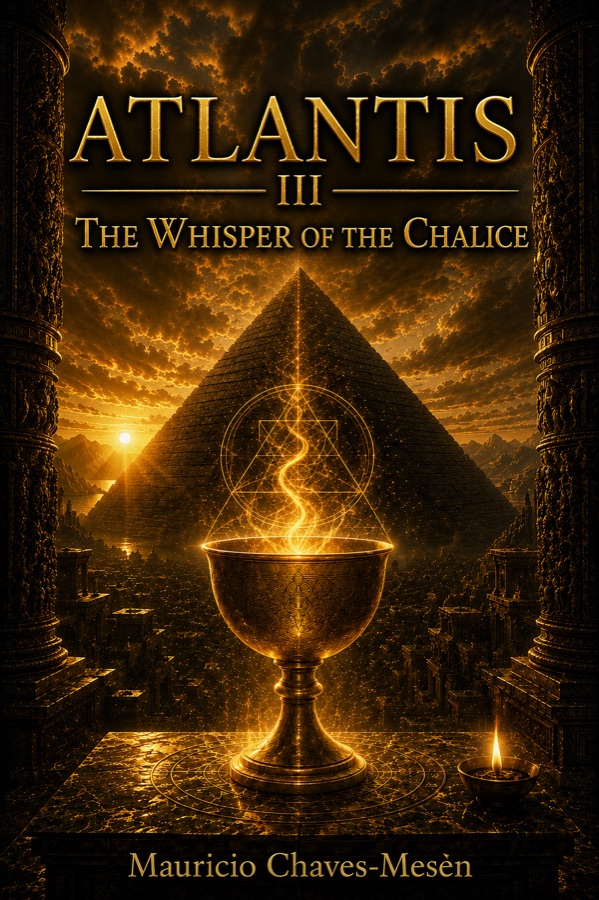
Atlantis · No. 3
Atlantis III: The Whisper of the Chalice
The final secrets of Atlantis are revealed. The chalice holds the key to a truth that will change everything.
Buy
Coming soon
Atlantis · No. 3
The final secrets of Atlantis are revealed. The chalice holds the key to a truth that will change everything.
Buy
Characters
Characters coming soon.
Author's Favorite
The author will share his favorite passage from this novel. Coming soon.
Read First Pages
1
Nubitlán, 5 Grel
Dawn found Persélope upon the upper terrace of Villa Tokrán North.
Gently swaying in a hammock, she savored her second glass of saí–peí as she watched the sun rise in the east, lifting from the waters as though it were being born from the depths of that crystalline ocean.
To the south, the Columnae rose—majestic and unbroken. In Nubitlán, where no construction exceeded three levels, the view spread wide and unobstructed over that imposing structure that crowned creation in that region of the planet.
To the north, only a few steps from her villa, began the forests planted by her ancestors, following the recommendations of the engineers of the god Azáes.
In that natural sanctuary there existed an ideal communion among species, each receiving the exact proportion of sun, water, and nutrients. This equilibrium fashioned a paradise of perfect energies, where even the winding springs traced, in their passage, figures of sacred geometry—as if the waters possessed the innate wisdom to flow through channels that harmonized all they bathed.
In this privileged land of plains and gentle hills, the territories to the west sheltered the Tokrán vineyards, from whose grapes was born the most exquisite saí–peí on the planet—an elixir capable of carrying whoever drank it into ecstasy.
At nearly fifty, Persélope Tokrán was a woman who inspired admiration, envy, and a certain fear. Her beauty had ripened like the finest of her saí–peí, acquiring a serene elegance that contrasted with the fire in her eyes whenever she debated the matters that kindled her: the study of souls, the cycles of reincarnation, the interwoven nature of all consciousness—fields in which she was deemed the greatest of scholars.
Her family’s fortune, one of the oldest in Nubitlán, allowed her to devote herself to these inquiries without worldly concern.
Behind that façade of intellectual aristocrat and perfect hostess there hid a woman marked by a profound loss: the death of her only daughter, a tragedy that had altered the course of her life, turning her interest toward the study of the soul, death, and what might exist beyond.
As she listened to the song of thousands of birds—one of the keenest pleasures of her mornings—she drank the last of her cup, recalling Noah’s words as they loved one another:
“From now on, if my actions make it seem that I am betraying you, or that I am not on your side, it is not true; if it happens, it will be an act—the manner I deem correct in that moment to achieve our objectives. More than ever, trust me, whatever may come.”
Persélope wondered how that warning would take form; what Noah might do to make even her—who trusted him so blindly—doubt.
Her thoughts were interrupted when Zamí, the Witucka of the ivá-petíat, appeared upon the terrace.
“Are you well?” Zamí asked, moving toward the hammock beside hers.
Persélope lifted her cup, made the gesture of a toast, and took a sip.
“As long as I have saí–peí, I am well,” she said, with a touch of bitterness.
The truth was, the smile at the party, Nogog, Noah’s wedding to Megá, the end of Atlantis … there were too many things in her mind for her to be well.
The tensions had eased a little. She accepted that Noah had not betrayed her with Megá; and Noah accepted the smile with Nogog as an accident.
The night before she had slept with him, had loved him; and before he returned to his palace, they had reminded each other of their willingness to fight together to the very end.
That pleased her; it gratified her to see a man so powerful surrendered at her feet, while she, in turn, gave herself over completely.
From there, to everything being well, forgotten and forgiven…
It did not help that the end of the world drew nearer with every heartbeat, with every breath, without her having been able to advance in her studies of souls, nor to come closer to solving their riddles.
She did not say it; she was not given to complaint.
Zamí, who knew the state of her friend’s mind, embraced her.
“Shall we begin with the projection of the soul?”
“First let us continue to understand the effect of the chalice, and try, as much as possible, to reproduce the Celetía,” Persélope replied.
“Have the ingredients for the brew arrived?”
“They should arrive at any moment. And as for the original recipe, Noah promised me he would speak with Sherzám in these days.”
“Good. Without brews, it is well to see how far the prophetesses’ powers reach by nature—only the chalice, if it pleases you.”
“You are the one who knows these things. I only study souls from theory; you are the one who harmonizes energies and understands practical matters.”
“Do not rob yourself of merit—you are in tune. I have seen how you flow in your trances.”
Persélope smiled. It was true. She would sit, meditate, listen to the Nahuek, and her body would awaken; she would see things and enter into communion with the Great All.
She had also been feeling the disturbance Zamí had mentioned in the first days, which foretold that something not good was about to occur. That was why they had to hasten their own investigations and discoveries. She had the sense that with every passing instant they were drawing nearer to the moment when it would be too late.
The day began hot, but the nearness of the forest tempered the air until it made a perfect temperature.
Zamí poured herself a cup of saí–peí and sat in the hammock beside Persélope to listen to the birds’ song.
“I could grow accustomed to your home,” Zamí said, smiling. Persélope had lived alone in that villa for more than ten years. Designed by Potará, disciple of Anatí, it melded with its surroundings, following the sacred patterns so prized by the architects of Atlantis. Those who arrived there for the first time said they felt an uncommon peace and harmony.
Whether due to her stay of a few days in Villa Tokrán, or to having spent a day wrapped in the mist of the el–kenáro, an extraordinary change had taken place in Zamí. With her imposing two-meter figure, the one hundred and twenty-year-old woman had recovered a surprising freshness. Where once one saw an old woman, now there appeared a woman of notable vitality. The phenomenon was no longer a subject of conversation. Persélope no longer smiled in complicity nor congratulated her on that transformation; she accepted it as what it was. If the Source had so decided, what was the point of questioning—or commenting upon—the obvious?
Zamí watched Megá’s el–kenáro descending in its usual place.
Setting aside her cup, she rose from the hammock.
“Come—let us begin,” she said.
2
Megá and Athena, seated in opposite positions, watched in silence as Zamí prepared the session.
The witucka, born a century before on the second solstice of the prophets, was the closest thing to a Tún Celét without being one, and that was why she integrated so perfectly with the prophetesses.
They had each described the rituals of the Celetía to her, so that she could design an experiment as close as possible.
“We will form a YAVÁ, the most stable geometry for what we are attempting—explained Zamí. She lit sandalwood candles around a circle traced on the floor of the hall and set quartz crystals with precision at specific points of the circle, moving with a fluidity that belied her age.”
Among the prophetesses, upon a small obsidian base, rested the chalice stolen from the temple by Athena.
“As I promised, I searched Noah’s library for information on the Tún Celét—Megá interjected. “Nothing about the brew; of the chalices it is said they are not mere ritual objects, but conductors, a bridge between dimensions, designed to amplify the natural capacities of the prophets. It is similar to what Hakel said, who considered them keys. Each one is unique; it opens a door, a dimension, a possible future, and that is why each prophet’s visions sometimes differ slightly around the same events. But when they are used together, they reveal their true purpose.”
Athena studied the chalice with fascination, wondering whether it might have any effect without the temple’s ceremonies and brews.
The tension between Megá and the demigoddess, though soothed by their shared goal, remained palpable. Persélope noted it in the way they avoided direct eye contact, in the rigidity of their postures when they were too near.
Zamí, giving the preparations as finished, stated with diplomatic calm:
“The chalice answers to harmony. Discord blocks its power. During the session, differences must be set aside.”
The prophetesses nodded, aware of what was at stake, confirming that the tension was evident.
The three took their places, forming a triangle within the circle, and placing one hand upon the chalice, positioned at the center.
Zamí took the reins.
“We will close our eyes and breathe deep—instructed Zamí. “We will feel the energies mixing, fusing, without forgetting that the chalice is only a conductor; the true power lies in the minds.”
“Will we make an intention?” asked Athena.
To wrap the minds around an intention was a way of guiding the chalice toward a concrete outcome.
In the Celetía, the prophets recited their intentions aloud before beginning: ‹‹we want to see what will happen in Atlantis during the next three months›› was often a generic intention that yielded very broad results.
“For this first session, let us leave the mind blank” suggested Megá, recalling Hakel’s lessons. “Let the chalice tell us what it wishes to tell us; let us surrender to its priorities. It is a purer way to experience its power.”
As on previous days, Persélope began the ritual drum, a deep rumble that reverberated in the soul.
Tan! one two three
Tan! one two three
Tan! one two three
Megá closed her eyes, accustomed to such meditative states. Athena, newer to these practices, kept hers open a moment longer, watching the witucka.
“Do not struggle” Zamí advised, noting her resistance. “Let yourself be carried. Your maatán blood is no obstacle; it is another layer of perception.”
The moment Athena closed her eyes, the candlelight wavered, as if a breeze had suddenly entered the hall.
“Now, let us listen. What would you tell us, O sacred chalice?” asked Zamí, herself entering deep states.
When she judged that the women in the triangle had reached a trance, Persélope, seated at a certain distance and though she herself felt effects, set aside the drum and, taking a parchment, prepared to record any word or sound they might utter.
The first to speak was Megá, her voice transformed—deeper and more resonant.
“The columnae breathe... The lightning seeks its path...
Athena tensed, her body vibrating as if an electric current were running through it. Zamí remained serene in her place, serving as anchor for the two young women who were beginning to sink into altered states of consciousness. Their eyes moved quickly beneath their lids, as though following unseen scenes.
The chalice began to shine with an inner light, a faint glow that lit their faces from below. Persélope held her breath. The object, inert until now, pulsed with a life of its own.
Megá let out a gasp.
“I see it... The place where the earth trembles but does not break... Where the sleeping fire awakens...”
“The cavern of reddish rocks... The first Meriaá...” Athena continued, as if they were witnessing the same vision from different angles.
Their words, though fragmentary, had an inner coherence that Persélope strove to capture. They were not mere visions, but precise information.
All at once, Athena loosed a muffled cry. Her hand cramped upon the chalice, and her whole body tensed as if resisting an unseen force. The chalice’s brightness intensified.
“Let us not break the triangle” warned Zamí, her voice calm. “Whatever happens, let us not release the chalice.”
The air grew dense, charged with electricity. Persélope felt it was hard to breathe, as if an invisible pressure squeezed her lungs. The candles fluttered violently and went out all at once, leaving the chalice’s glow as the only source of light.
In the partial darkness, shadows were cast grotesquely, swollen upon the walls. Persélope watched, caught between fascination and terror, as the shadows seemed to take on a life of their own, moving independent of the bodies that ought to have been casting them.
“Let us not break the triangle!” Zamí repeated with greater urgency when Megá began to tremble without control.
“I cannot contain it...—moaned the young prophetess—.
“Together—said Athena, extending her free hand to take Megá’s. “Our minds, united, are stronger.
The gesture—this simple act of solidarity between two women who days before had been enemies—seemed to change the room’s very dynamic. The shadows drew back, the air grew lighter, and the chalice steadied into a constant, comforting radiance.
And then, as abruptly as it had begun, the phenomenon ended. The glow died, the shadows vanished, and the women of the triangle collapsed—exhausted, yet conscious.
Continue in the full book →